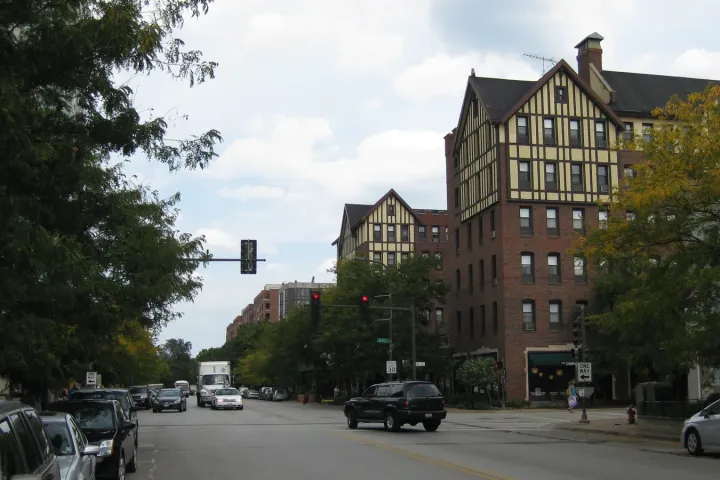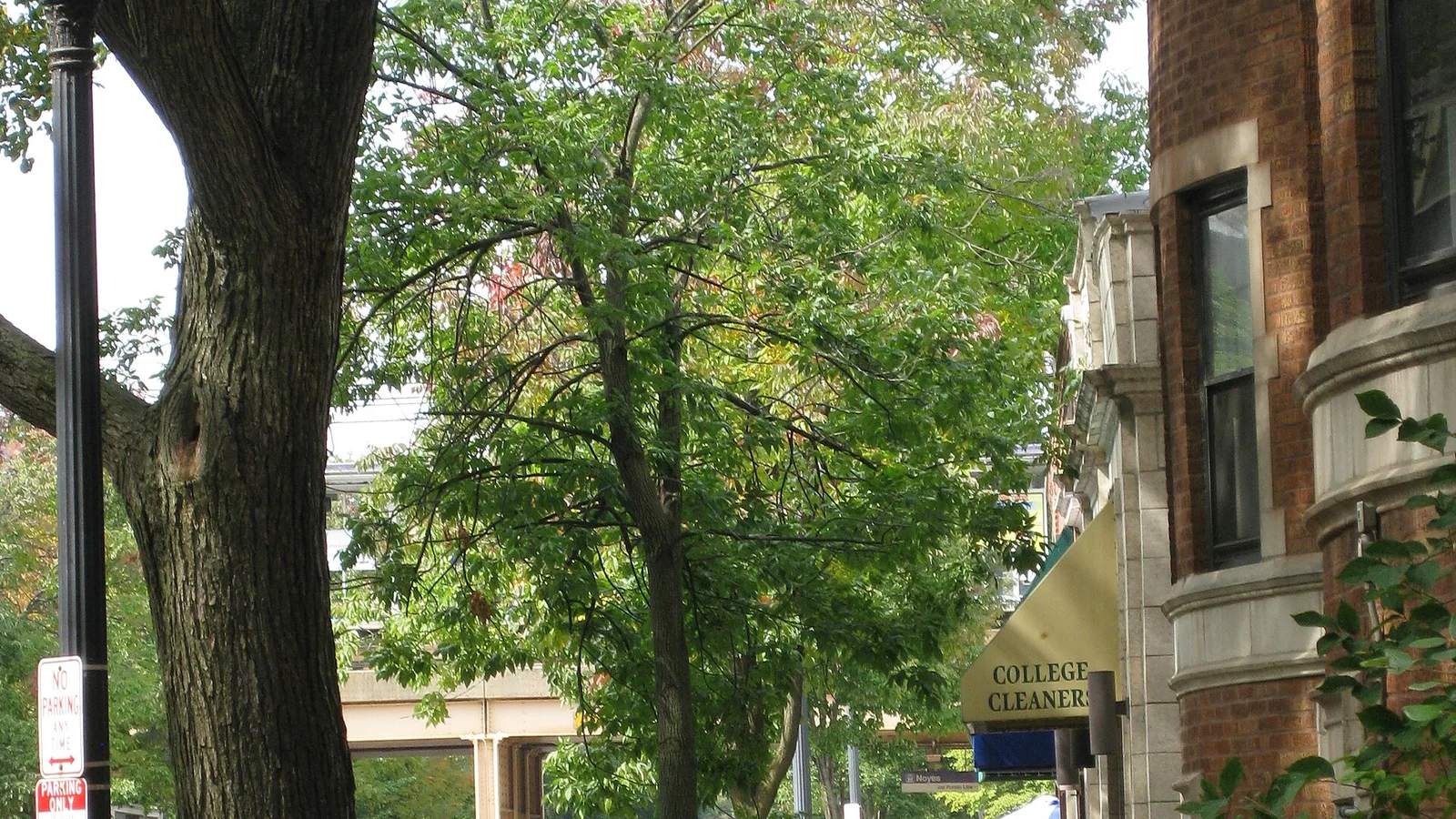
A tree-lined residential block in Evanston. Photo: Eric Fredericks from Rancho Cordova, CA, United States / Wikimedia Commons, CC BY-SA 2.0
In the years after the Civil War, Black families arrived in the Village of Evanston and many turned their skills into small businesses. One of the best known was Richard Day, a young man who sold his labor in more ways than almost anyone in town and earned respect from Black and white residents alike. His story was told by the Shorefront Legacy Center, the Evanston nonprofit that preserves North Shore Black history, in an article by Rhonda K. Craven.
From Kentucky to Davis Street
Day was born Richard Mussleman around 1848 in Harrison, Kentucky, and took the surname of the last man who enslaved him. By 1870 he owned a home at the northeast corner of Judson Avenue and Dempster Street and worked as custodian of the Congregational Church. In 1873 he and John Smith advertised a lawn-cutting business on Davis Street. Day became known around town as “Richard the Lawn Cutter” for the badge he wore on his hat.
Between 1874 and 1876 he added stove blacking, brickwork, calsomining, whitewashing and carpet laying and cleaning, and later an express wagon for moving goods. Carpets became his best-known trade, and he devised a frame with a roller for beating them, which the Evanston Index praised in 1882. He also gave horseback riding lessons, ran a poultry market on Davis Street near Fountain Square, worked as a nurse and hired out women to clean homes.
Church and civic leader
Day joined the Baptist church in 1875 and married Addie Grayson of Battle Creek, Michigan, that summer. He held offices in the Good Templars and Mount Moriah Lodge. In July 1882 he chaired a joint service of Black Baptists and Methodists, a gathering that led to the founding of Ebenezer A.M.E. Church and Second Baptist Church that fall. In 1888 he organized a group of Black Republicans and served as president of its marching club.
He and his wife had five children, but only two sons, Walter and Jewell, survived. Walter later worked as a pressman for the Index, and Jewell at a local bakery.
Final years
Day fell ill in 1890 and moved to Colorado Springs in hope of recovery, then returned to Evanston as his health worsened. He died of consumption at home on Sept. 3, 1891. Services were held at Second Baptist Church, and he was buried at Rose Hill.
Craven describes him as one of the most prolific and successful early Black professionals in Evanston. A 1929 account by Frederick E. French, cited by Shorefront, called him “a colored man of individuality.”
Rachel Lindqvist covers community life, the lakefront, dining and the arts for The Evanston Edge.