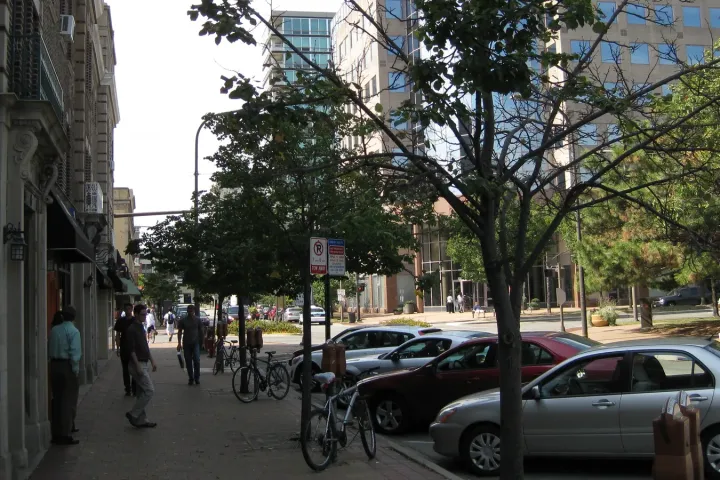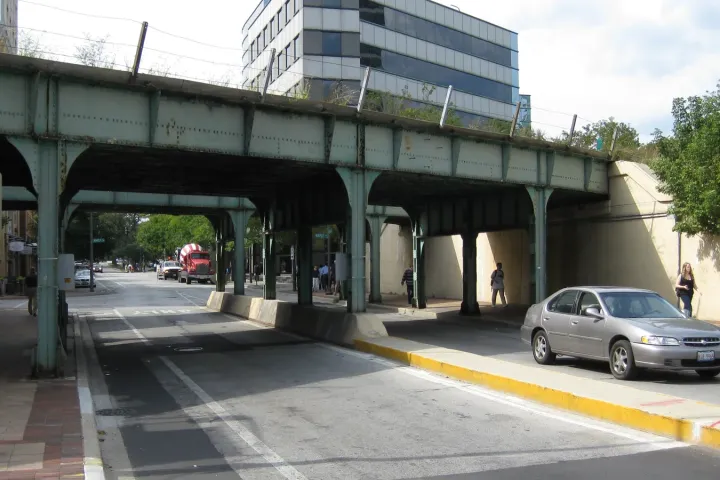
Haven Street in central Evanston, a city that once had a large steel pipe works. Photo: Nick Number / Wikimedia Commons, CC BY 4.0
Evanston is now known for a university, hospitals and a lakefront, and it is easy to forget that the city once made things at scale. For decades one of its largest employers was Clayton Mark and Company, a maker of steel pipe and related products that sold across the United States and well beyond.
A pipe mill on the North Shore
Clayton Mark was born in Fredericksburg, Pennsylvania, in 1858 and moved to Chicago at 14. He left school after the seventh grade and went to work as a file clerk at a malleable iron company, eventually rising to vice president. In 1888 he founded Mark Manufacturing Company with his father, Cyrus Mark. The firm began with well points, the devices used to draw groundwater, and expanded into steel pipe.
In 1900 he added a pipe mill in Evanston and founded Clayton Mark and Company. The Evanston business made wrought steel pipe and water well supplies. Over time the product line grew to include forged steel unions, which are high-pressure fittings, as well as steel tubing, Mark conduit for electrical wiring and water well systems. The company’s unions went into oil wells from Texas to Arabia.
The city’s largest employer
The company is described as Evanston’s single largest employer in its day, with annual sales above $10 million. That figure is undated. Several of Mark’s sons held positions in the firm, among them Clarence, Clayton, Cyrus and Griffith. It was a family manufacturer, and the factory floor was a regular part of Evanston’s economy.
That is a useful contrast with the present. In a list of the city’s top employers dated 2015, the biggest names were Northwestern University, a hospital system and school districts. The largest manufacturer on that list, C.E. Niehoff and Company, was tenth with 450 employees.
Outgrowing Evanston
The Evanston plant also helps explain a better-known piece of Midwestern industrial history. A 2017 WBEZ story on the planned community of Marktown says the company had outgrown its Evanston factory, which led Mark to build a steel mill and a town for workers in northwest Indiana. His Indiana Harbor steel mill dates to 1916. Marktown, in East Chicago, Indiana, was begun in 1917 to house the mill’s workers and was designed by the architect Howard Van Doren Shaw. It was meant to hold about 190 acres of housing for 8,000 people, but only around 40 acres for 1,200 residents were built, according to WBEZ. The district was added to the National Register of Historic Places in 1975.
Mark was active outside business as well. He served on the Chicago Board of Education from 1896 to 1905, including as its president from 1902 to 1905, and led the Civic Federation of Chicago for several terms between 1907 and 1929. He died in 1936.
The sources reviewed here do not say when the Evanston operation ended, and they describe the company only in the past tense. What they do establish is that for a good part of the twentieth century, a family-run pipe maker in Evanston supplied oil fields, farms and builders, and that its growth helped shape a planned town in another state.
Add The Evanston Edge as a preferred source on Google (opens in a new tab)