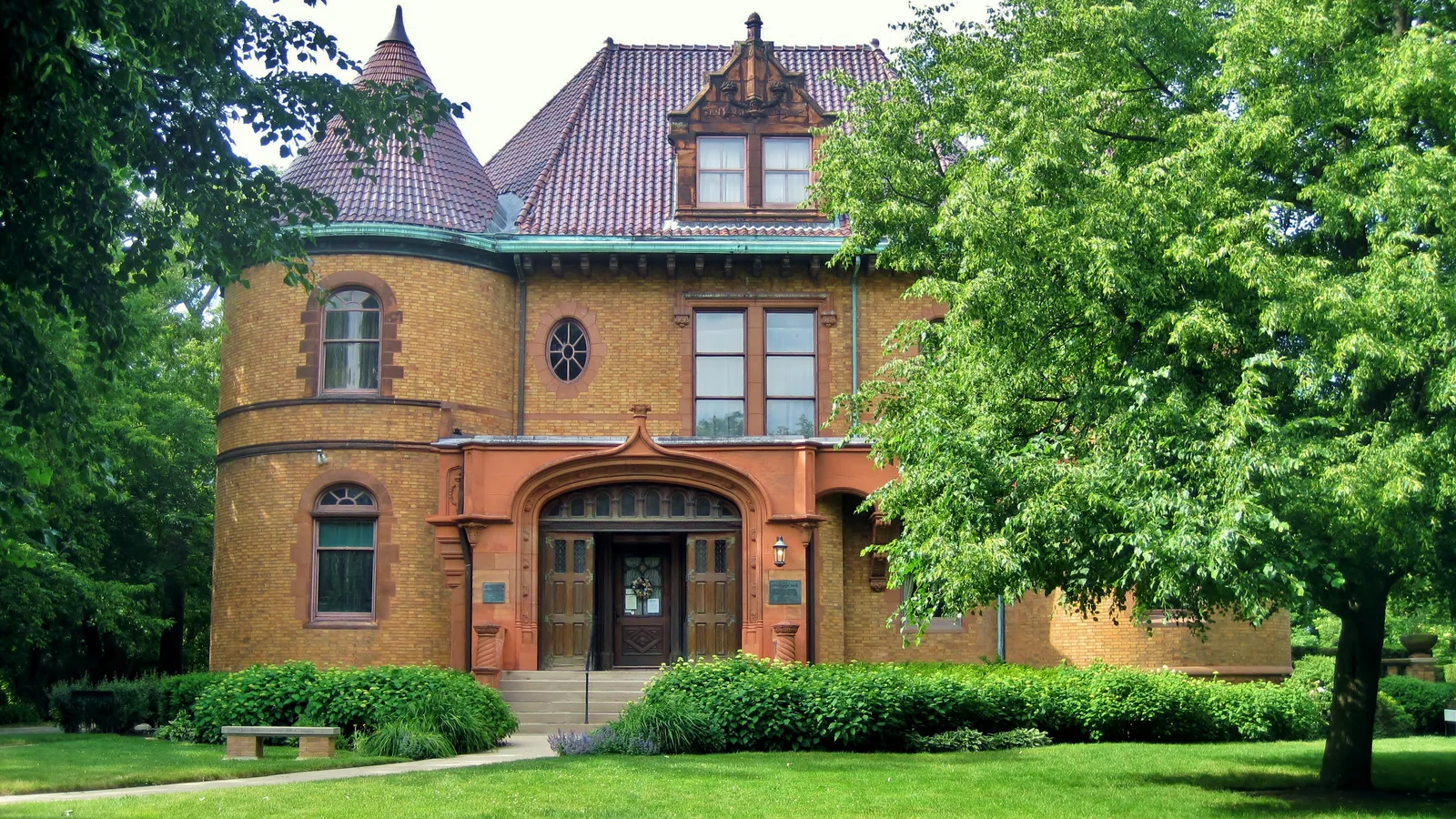
The Charles G. Dawes House on Greenwood Street, now home to the Evanston History Center. Photo: Teemu008 from Palatine, Illinois / Wikimedia Commons, CC BY-SA 2.0
Charles G. Dawes held a long list of titles: banker, budget director, vice president of the United States, ambassador to Britain. One address anchors most of his life after 1909: 225 Greenwood St. in Evanston, where he died in 1951.
From Ohio to Chicago finance
Dawes was born Aug. 27, 1865, in Marietta, Ohio. He graduated from Marietta College in 1884 and Cincinnati Law School in 1886, practiced law in Lincoln, Nebraska, from 1887 to 1894, and moved to Chicago during the Panic of 1893. He served as Comptroller of the Currency from 1898 to 1901 under President McKinley. In 1902 he founded the Central Trust Company of Illinois and led it until 1921. That year he became the first director of the Bureau of the Budget under President Harding.
His blunt style produced a famous line. At 1921 Senate hearings on wartime spending, he exclaimed that the Army had not been trying to keep a set of books but to win a war, using the phrase “Hell and Maria.” It stuck as a nickname.
The Dawes Plan
His best-known public work was chairing the committee behind the Dawes Plan. French and Belgian troops had occupied Germany’s Ruhr in January 1923 after Germany was declared in default on reparations. The plan, signed Aug. 16, 1924, and in effect Sept. 1, 1924, set a staggered payment schedule that started at 1 billion Reichsmarks in the first year and rose to 2.5 billion after five years. It arranged an 800 million Reichsmark loan to stabilize the German currency, about half raised through bond sales on Wall Street. The occupation of the Ruhr ended Aug. 25, 1925.
Germany’s economy recovered for a time. But the recovery depended on large foreign borrowing, much of it short-term. The Young Plan replaced the Dawes Plan in 1929. Dawes shared the 1925 Nobel Peace Prize for the work.
He served as the 30th vice president from March 4, 1925, to March 4, 1929, under Calvin Coolidge, and clashed with the Senate over filibuster rules. Herbert Hoover then appointed him ambassador to the United Kingdom, a post he held from June 15, 1929, to Dec. 30, 1931.
The house on Greenwood Street
The Chateauesque house was built in 1894 for Robert Sheppard, a Northwestern University treasurer and business manager, and designed by New York architect H. Edwards Ficken. Dawes and his family lived there from 1909 until his death on April 23, 1951. His wife, Caro Blymer Dawes, stayed until she died in 1957.
Dawes gave the house to Northwestern in 1944 with the understanding that it would house the Evanston Historical Society, which moved in in 1960. Northwestern donated the house to the Evanston History Center in 2009, and the center has its headquarters there. The house was added to the National Register of Historic Places and designated a National Historic Landmark on Dec. 8, 1976. Docent-led tours cover the library, dining room, kitchen and great hall, furnished with pieces that belonged to the Dawes family.
Add The Evanston Edge as a preferred source on Google (opens in a new tab)
Daniel Okafor covers business, startups and the Innovators section for The Evanston Edge.