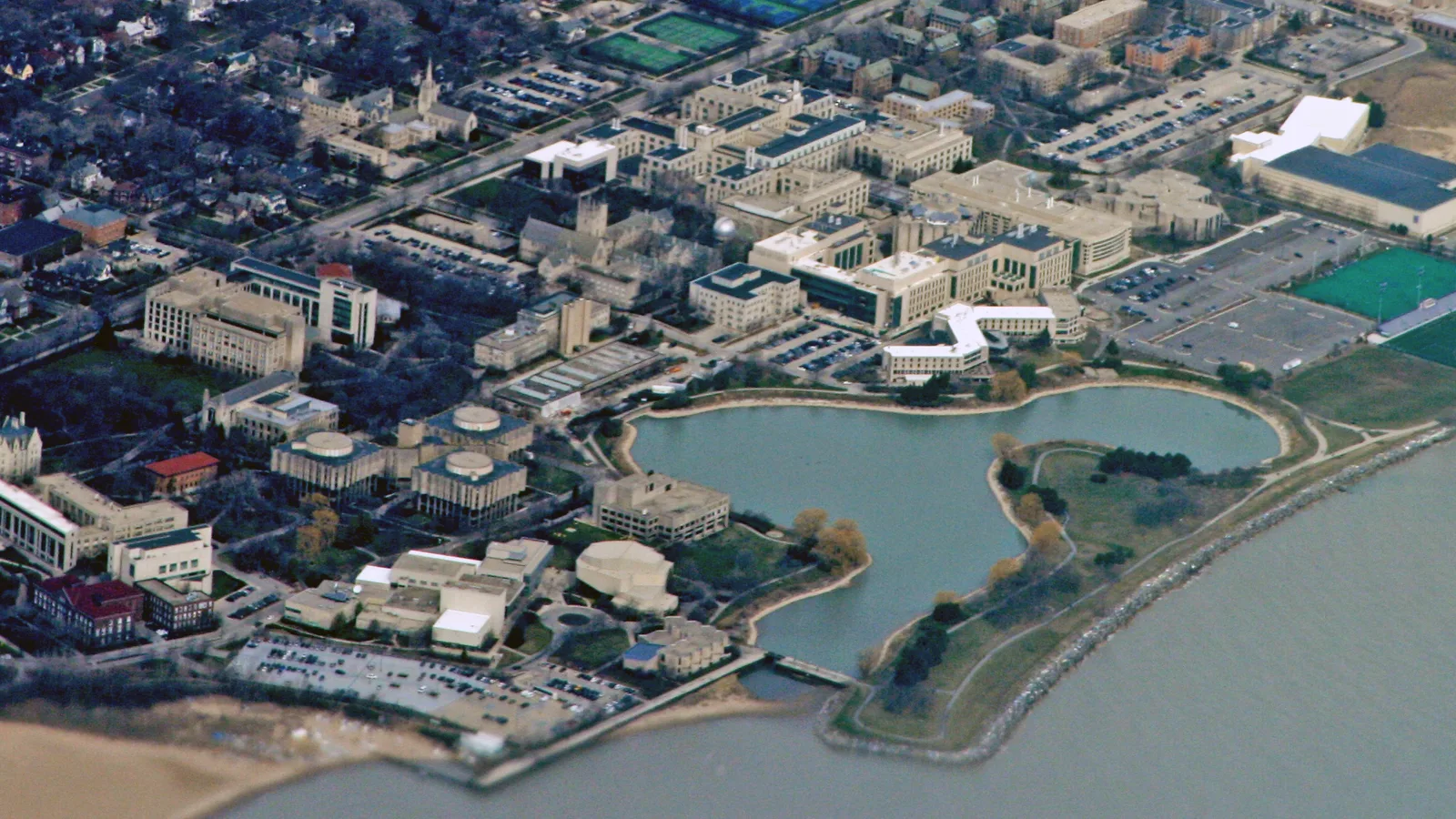
Northwestern University's Evanston campus. Photo: Madcoverboy (talk) / Wikimedia Commons, CC BY-SA 3.0
Evanston’s economy rests on institutions more than on factories or corporate headquarters. The clearest evidence is the list of the city’s largest employers, which is topped by a university, a hospital system and two school districts.
The 2015 ranking
The published list, attributed to the Illinois Department of Commerce and Economic Opportunity and to the employers themselves, is dated 2015. Its top ten, with headcounts:
- Northwestern University, 9,471
- NorthShore University HealthSystem, 3,727
- Evanston-Skokie School District 65, 1,600
- Saint Francis Hospital, 1,272
- City of Evanston, 918
- Presbyterian Homes, 602
- Rotary International, 525
- Evanston Township High School District 202, 520
- Jewel-Osco, 480
- C.E. Niehoff and Company, 450
These are 2015 figures, and headcounts at several of these employers may have changed since. Northwestern alone employed more than the next three combined. Public and nonprofit institutions fill most of the table, with only a grocery chain and an industrial manufacturer representing the private sector.
What that means for the tax base
The concentration has a fiscal edge. Northwestern’s 1851 founding charter exempted the university from property taxes. The university pays water, sewer, communications and real property transfer taxes, as well as building permit fees, but it does not pay property taxes and makes no payments in lieu of taxes for real estate it removed from the tax rolls.
That has produced a long-running argument. In 2000, an advisory referendum known as the Fair Share Initiative asked Northwestern to pay a fair share for city services, and it passed with 83.5 percent of the vote. In 2005 the university bought an eight-story downtown office building, which took that property off the tax rolls. In 2015 Northwestern and the mayor announced that the university would donate $1 million a year to city services and programs.
Backers of the university’s tax treatment argue that its status as an elite research institution justifies it, and that its students and faculty are a major customer base for local businesses. Both sides are describing the same fact: the biggest payroll in town comes with a smaller property tax footprint than a private employer of similar size would carry.
One caution applies to any ranking of this kind. Headcount measures jobs located in Evanston, not the wages paid or the share of workers who live in the city, and the 2015 list does not say how many of these employees are residents. It also counts the City of Evanston itself, whose payroll is funded by the same tax base the larger institutions help to shape.
A city of about 76,000
The 2020 Census counted 78,110 residents, and the Census Bureau’s 2024 estimate is 76,006, a decrease. The 2010 Census figure was 74,486. In a city of that size, any large institutional purchase that comes off the rolls is felt more than it would be in a bigger place.
The employer list also shows what is missing. There is no large corporate headquarters on it, and the one manufacturer sits at the bottom. The employment base is stable in the way that universities and hospitals are stable, but it leaves the city leaning on a narrow set of anchors and on the voluntary payments they agree to make.
Thomas Brennan covers property taxes, real estate, transit and the local economy for The Evanston Edge.