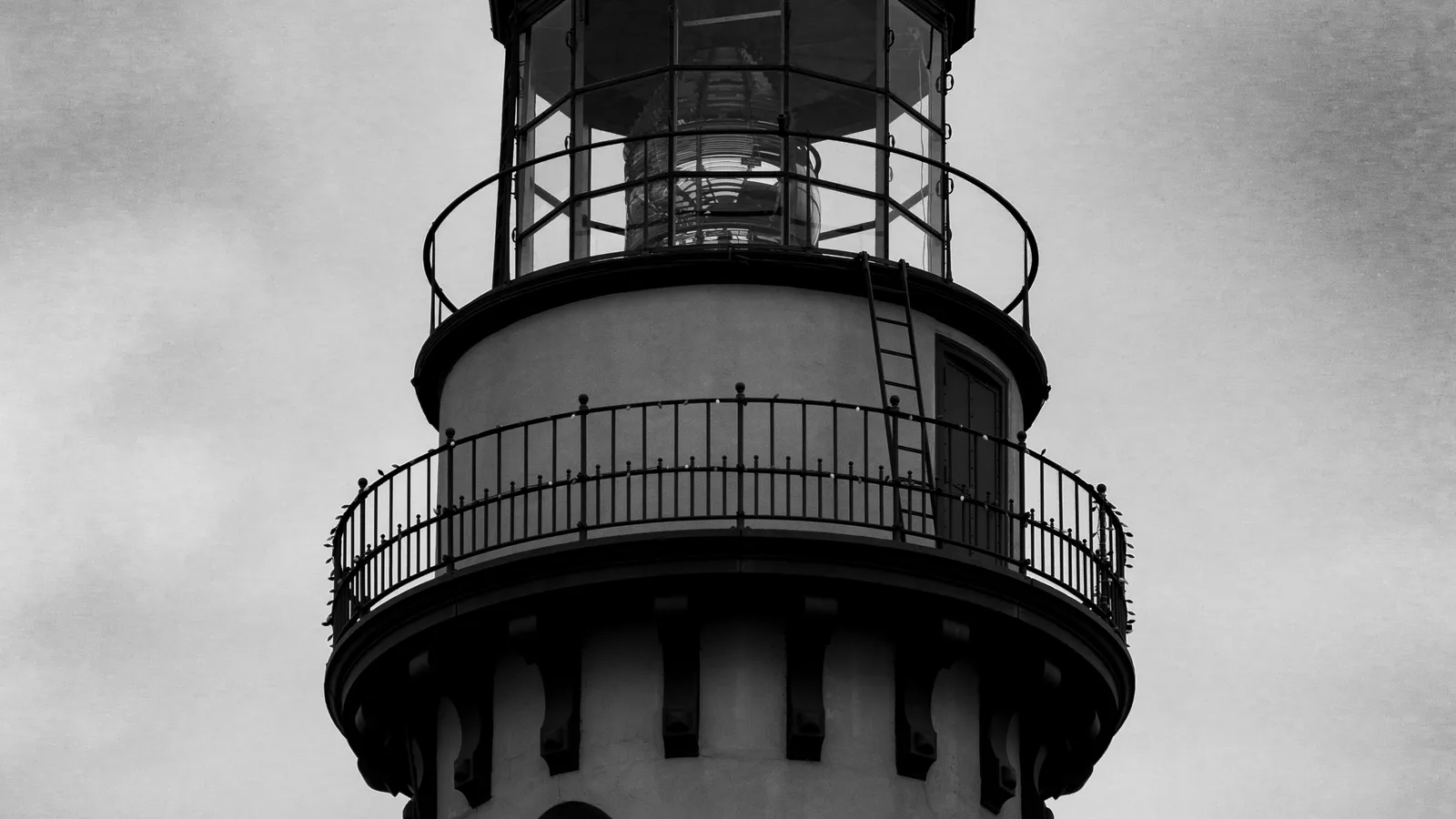
Grosse Point Light on the Evanston lakefront. Photo: James Conkis / Wikimedia Commons, CC BY-SA 4.0
At the foot of Evanston’s north end, the lakefront packs in a federal lighthouse, a public beach and a 1920s mansion with a landscape by one of the Midwest’s best-known designers. They sit next to each other, and together they make the most recognizable stretch of shoreline in the city.
The light
The Grosse Point Light has its roots in a shipwreck. The sinking of the Lady Elgin in 1860 helped build support for a lighthouse, and construction began in 1872. Most of the work was complete by June 30, 1873, and the light began operating in March 1874.
Orlando Metcalf Poe, the Lighthouse Board’s chief engineer, supervised the project and designed the buildings. The tower is 113 feet tall, a conical Italianate structure of Cream City brick encased in concrete and attached to a storage building. It is painted yellow with red trim and a red roof. Its second-order Fresnel lens, still in place, shows two white flashes every 15 seconds.
The station was automated in 1935, and the federal government turned the grounds and buildings, apart from the tower and light, over to Evanston. The Coast Guard decommissioned the light in 1941 after Pearl Harbor, and the city received the tower. It was relit in 1945 or 1946 (accounts differ) as a secondary aid to navigation. The lighthouse was added to the National Register of Historic Places on Sept. 8, 1976, and designated a National Historic Landmark on Jan. 20, 1999. The Evanston Lighthouse Park District maintains it, and the dwelling and tower are open for tours on summer weekends.
The beach and its neighbors
Lighthouse Beach takes its name from the tower beside it, along Sheridan Road a short walk north of Northwestern’s campus. Lawrence O. Lawson Park and Noah’s Playground are adjacent. The American Planning Association’s profile of the Central Street area, which lists Lighthouse Beach among its recreation spots, says Noah’s Playground opened in 2008 as an accessible play space.
The Daily Northwestern has reported that the city removed dead and dying trees and non-native plants from the beach area to improve wildlife habitat and safety. Beach fees and hours vary by season and by source, so check with the city before going.
The Harley Clarke grounds
Next door at 2603 Sheridan Road is the Harley Clarke Mansion, a French Eclectic house completed in 1927 and designed by Richard Powers for utilities executive Harley Clarke. The three-story, 16-room limestone house and its coach house were landscaped by Jens Jensen working with Alfred Caldwell, with a wooded bluff leading to a private sand beach. Surviving elements include a hemlock-shaded pond with a waterfall, a council ring, terraces and paths.
The Clarke family sold the property in 1949 after Depression-era losses. Sigma Chi used it as national headquarters from 1951 to 1965, when the city bought it. The Evanston Art Center leased it from 1966 to 2015. Evanston declared it a city landmark in 1982, and Landmarks Illinois listed it as endangered in 2016.
Its future was contested. In 2018 the city moved toward demolition, but voters backed saving the house that November. In May 2021, the nonprofit Artists Book House received the keys under a planned long-term lease, with book arts studios, classrooms, a cafe and a bookstore in the plan. Available information runs only to about 2021 and 2022, so the current status may have changed.
Taken together, the three places show how the north end holds onto its shoreline: the lighthouse as working history, the beach as everyday use, and the mansion grounds as a public argument over what to keep.
Margaret Whitfield is the editor of The Evanston Edge and covers local government, development and neighborhoods.