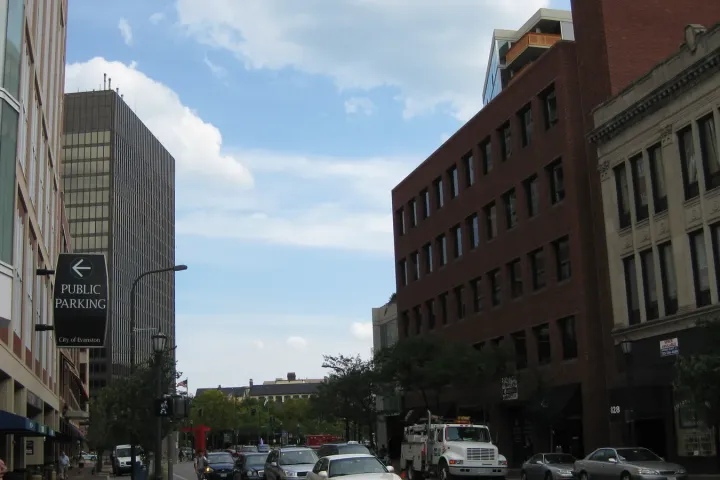
Isabella G. Butler Park in Evanston, named for Dr. Isabella Garnett. Photo: Nick Number / Wikimedia Commons, CC BY 4.0
In the early 1900s, a Black family in Evanston who needed more than emergency care had few places to turn. Dr. Isabella Garnett spent much of her career changing that, first in the upper floor of her own home and later as superintendent of a hospital that served the community for decades.
A local family and a hard road to a degree
Garnett was born in Evanston on Aug. 22, 1872, one of seven children of Daniel and Hannah Garnett. Her parents were among the city’s earliest African American settlers and helped found Second Baptist Church. She did not finish high school, but she took business classes in Minneapolis and, starting in 1894, worked and studied at Chicago’s Provident Hospital. She earned a nursing degree in 1895 and worked as a school nurse for two years.
She went on to Harvey Medical College, where she received a premedical certificate, then to Chicago’s College of Physicians and Surgeons, which awarded her a medical degree in 1901. She was one of the first African American women to earn an M.D. in Illinois. She practiced on Chicago’s South Side before returning to Evanston by 1904. Throughout her career she used her maiden name professionally, though she married twice.
The sanitarium on Asbury Avenue
In 1907 she married Arthur Butler, a medical student who graduated from Northwestern University Medical School in 1909. By then, the Evanston Women’s History Project says, hospital care for African Americans in the area was very limited. In 1914 the couple opened the Evanston Sanitarium and Training School at their home on Asbury Avenue. The Women’s History Project lists it at 1918 Asbury Ave. and counts it as one of only four Chicago-area hospitals that admitted Black patients.
Butler died unexpectedly in 1924. Garnett kept the hospital running and renamed it Butler Memorial Hospital in his honor. Those were the years of the Great Migration, and Evanston’s Black population nearly doubled between 1910 and 1925.
Community Hospital
Garnett later joined forces with the Booker T. Washington Association of Evanston, which was working toward a hospital of its own. Sources differ on the date of the merger: the Evanston Women’s History Project gives 1928 for the joining and 1930 for the opening of The Community Hospital of Evanston, with Garnett as superintendent. It started in a local doctor’s large brick house with 18 beds, and a planned 50-bed facility was out of reach once the Depression set in.
She stayed on as superintendent until 1945 or 1946, depending on the source, and retired fully because of poor health. She died on Aug. 23, 1948, at the hospital she helped found.
Community Hospital outlived her. It grew to 56 beds in 1952 under Dr. Elizabeth Webb Hill, who became chief of staff, and kept serving patients of all races until it closed in 1980. The former hospital building was later converted into apartments for disabled adults and dedicated in 1986 as Hill Arboretum Apartments. In 1975 the city dedicated Isabella G. Butler Park along the North Shore Channel, near the old hospital site.
Add The Evanston Edge as a preferred source on Google (opens in a new tab)
Thomas Brennan covers property taxes, real estate, transit and the local economy for The Evanston Edge.