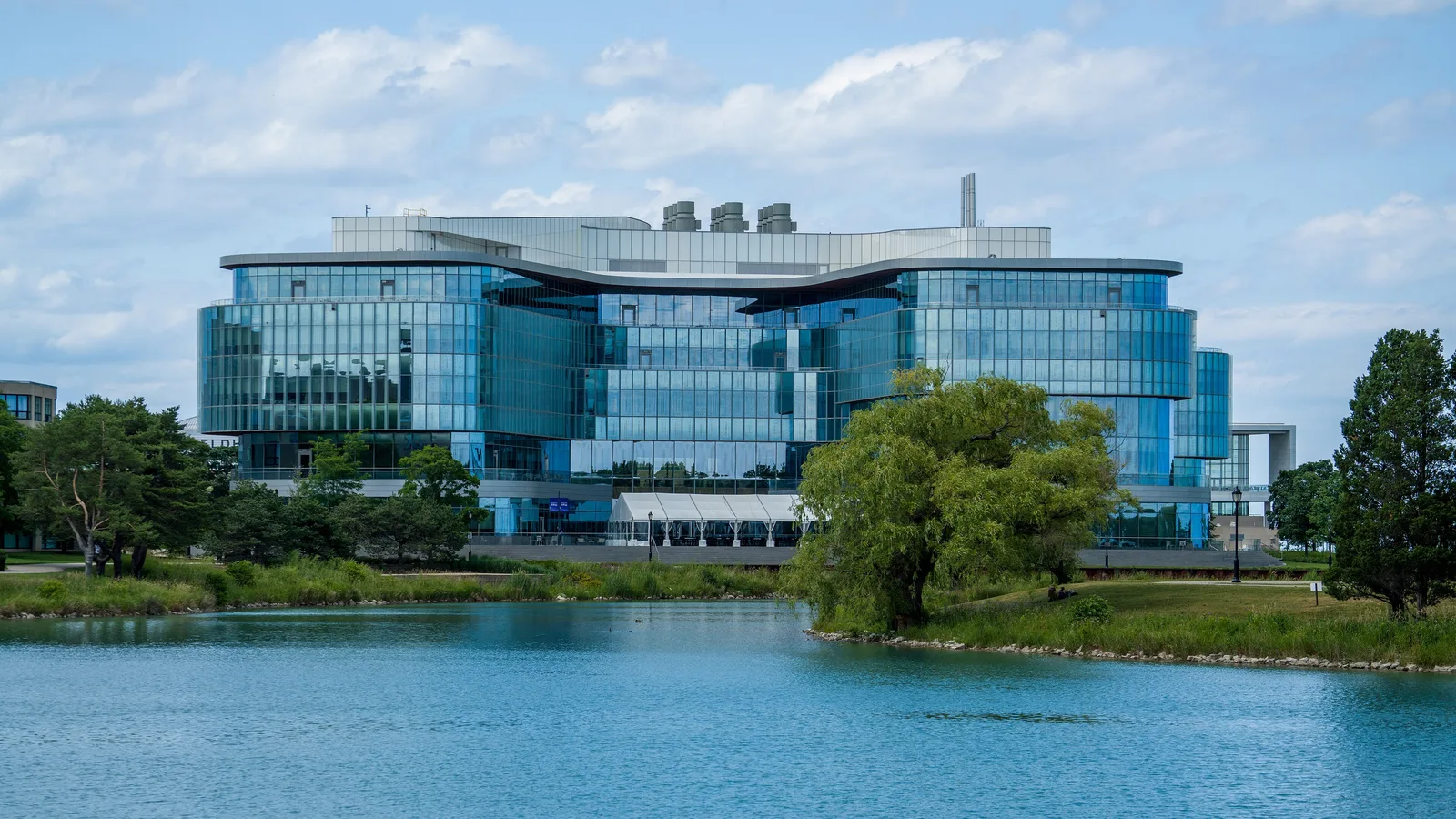
The Kellogg Global Hub on the Evanston lakefront. Photo: Joseph Gage / Wikimedia Commons, CC BY-SA 2.0
When people in Evanston talk about the economic weight of Northwestern University, they usually mean payroll and property. The Kellogg School of Management adds a different kind of presence: a lakefront campus, a steady rotation of graduate and executive students, and an alumni network that reaches far beyond the city.
A lakefront campus
Kellogg’s full-time and Executive MBA facilities are in Evanston on the Lake Michigan shore. Its evening and weekend MBA program is held at Northwestern’s Chicago campus in Wieboldt Hall. Full-time students take most classes in the Global Hub, which opened on March 28, 2017. The building covers roughly 415,000 square feet and was designed by the Toronto firm KPMB Architects. It has two atriums and a design lab with 3D printers and an art studio.
The school itself is old. It began in 1908 as Northwestern’s School of Commerce and took its current name in 2001, after earlier titles that included the J.L. Kellogg Graduate School of Management, adopted in 1979. Donald P. Jacobs served as dean from 1975 to 2001.
Executive students and a new building
Kellogg’s executive education began in 1951 with the Institute for Management in Evanston. Executive MBA students have been part of the school since the Executive Management Program was introduced in 1976. The James L. Allen Center has housed executive education since 1979 and is being replaced. Construction began in 2025 with completion expected in 2027, as part of a $600 million campaign called Full Circle.
Executive programs matter to a local economy because those students spend time in town without living there year-round. The sources reviewed for this article do not put a dollar figure on what executive students spend in Evanston, and no published local estimate turned up, so the size of that effect is unmeasured. The same is true of the school’s overall payroll: Kellogg is part of Northwestern, and the university’s finances are reported at the university level.
The alumni network
The school reports an alumni network of more than 67,000 graduates, with more than 60 regional clubs and over 20 special-interest clubs. Those graduates mostly work elsewhere, but the network is part of what keeps the brand valuable. Kellogg also opened a Miami campus in January 2006 for an executive MBA program aimed at Latin American executives, and has run a European program in Switzerland since 1965. Its reach is global even though its main campus sits in a city of 78,110 people, the 2020 Census figure.
Rankings are part of the pitch to applicants. The school’s 2026 U.S. rankings include fifth for the Financial Times MBA, fourth for U.S. News and third for Bloomberg. The full-time MBA class of 2026 is half women and 40 percent international, with an average GMAT of 733.
For Evanston, the practical question is how much of that prestige stays in town. The Global Hub and the Allen Center replacement are major projects on the lakefront. But Northwestern’s tax-exempt status, which dates to the university’s 1851 charter, means the university does not pay property taxes on its campus. That is the trade-off behind any discussion of Kellogg as an economic actor: it brings people and reputation to Evanston, and the numbers that would show the full effect have not been published in the sources reviewed here.
Daniel Okafor covers business, startups and the Innovators section for The Evanston Edge.