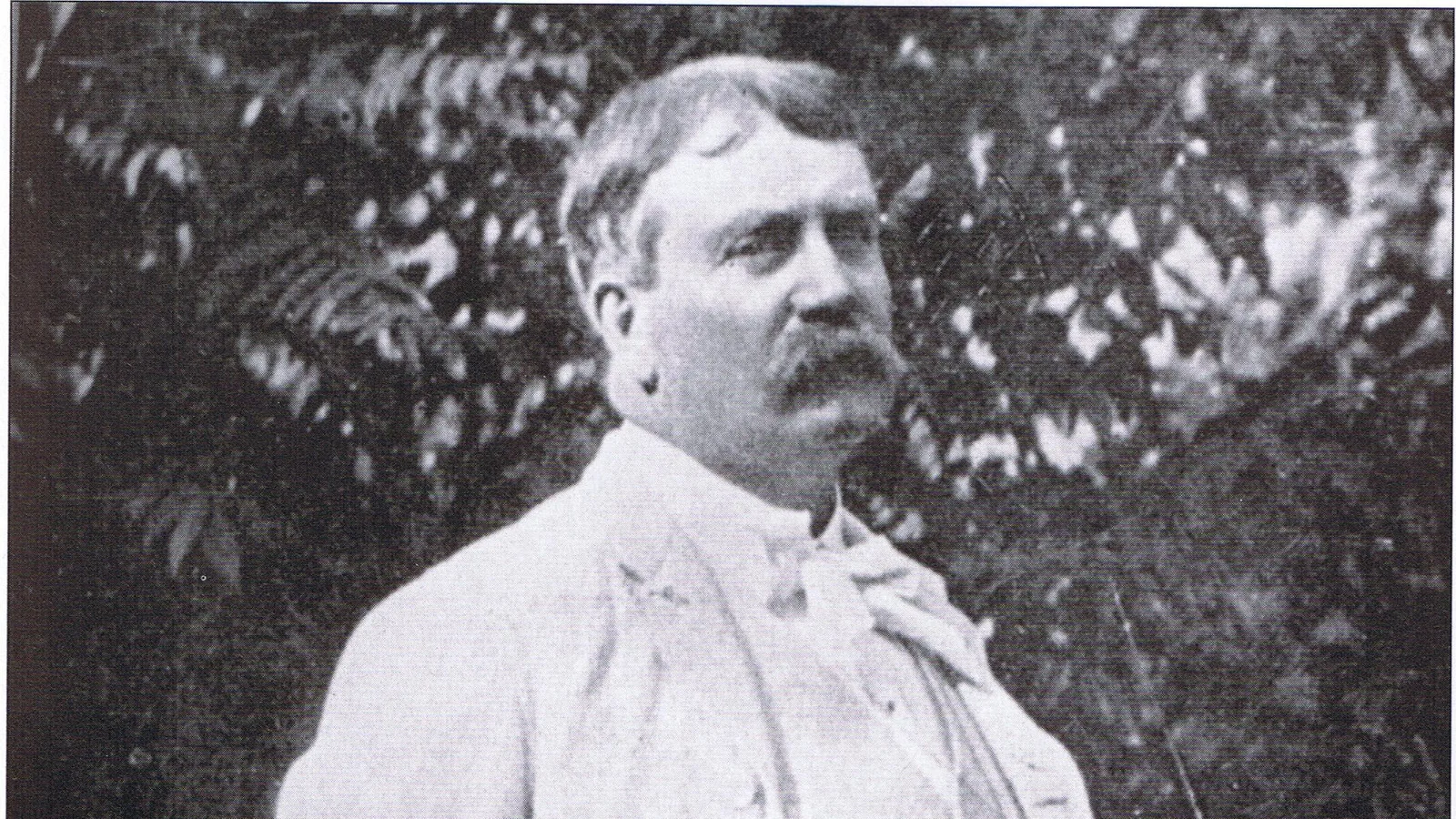
Daniel Burnham, Margaret Burnham Geddes's grandfather, on the terrace of his Evanston home. Photo: Unknown authorUnknown author / Wikimedia Commons, Public domain
Evanston has produced its share of architects, but Margaret Burnham Geddes is a less familiar name. She was born in the city on Sept. 26, 1907, and spent her professional life elsewhere. Her career was in Providence, Rhode Island, where she designed houses and later helped plan the city’s redevelopment. The Evanston link is her birth and her family; the source material does not tie any of her known buildings to the city.
A family with a famous name
She was born Margaret Kelly, one of five children. Her father, George T. Kelly, was a University of Wisconsin graduate. Her mother, Margaret Sherman Burnham, was the daughter of Daniel Burnham, the Chicago architect and planner. A public-domain photograph on Wikimedia Commons shows Burnham on the terrace of his Evanston home. The Kelly family moved to Providence in 1922.
Training
She graduated from the Wheeler School in 1925 and went on to Vassar College, where she studied art and mathematics until 1929 and was elected to Phi Beta Kappa. In 1930 she began studying architecture at the Massachusetts Institute of Technology. Her 1933 bachelor’s thesis, A Beach Development, proposed a project for a site in Narragansett, Rhode Island. It was never built.
Geddes & Kelly
In 1934 she formed Geddes & Kelly with J. Peter Geddes, a Columbia graduate. The firm worked mostly on houses and operated until 1948. Its best-known work dates from 1938 to 1941, and four of its houses were featured in Pencil Points and Architectural Forum in 1941.
Projects listed in her biography include the George R. Rowland House in Brookfield, Massachusetts (1938), the Narragansett Boat Club in Providence (1939) and the Harris House in Barrington, Rhode Island (1941). She married Peter Geddes in December 1942.
The couple’s own home on Manning Street in Providence, dated 1939, drew notice later. In 1992 the historian William Jordy described it as an early example of domestic modernism in Providence. It had been promised to Brown University in 1966, and Brown demolished it in 2015 to make way for an engineering research center designed by KieranTimberlake. It is unclear whether her other listed buildings still stand.
War work and city planning
During World War II the firm paused. She worked for the Federal Public Housing Authority in Washington, D.C., and served as an Army truck driver. After the war, her husband formed Harkness & Geddes in 1948, and she worked there part time while taking her own commissions. In 1950 she designed the Scott House in Providence.
In 1956 she joined the Providence Redevelopment Agency as a planner. She worked on the Constitution Hill rehabilitation area and helped pursue historic zoning on College Hill. She left in 1961 and continued as a planning consultant, including work on the Cape Cod sector of the Massachusetts State Plan.
She was also active in the League of Women Voters from 1952 to 1969, directing the Providence chapter from 1954 to 1956, and took part in the Rhode Island chapter of the American Institute of Architects and in Vassar alumnae groups. She died in Providence on Feb. 18, 1995, at age 87, and is buried at Swan Point Cemetery.
A woman born in Evanston, with one of American architecture’s best-known surnames in her family tree, became a working architect in the 1930s and then moved from designing houses to planning an entire city’s renewal.
Thomas Brennan covers property taxes, real estate, transit and the local economy for The Evanston Edge.