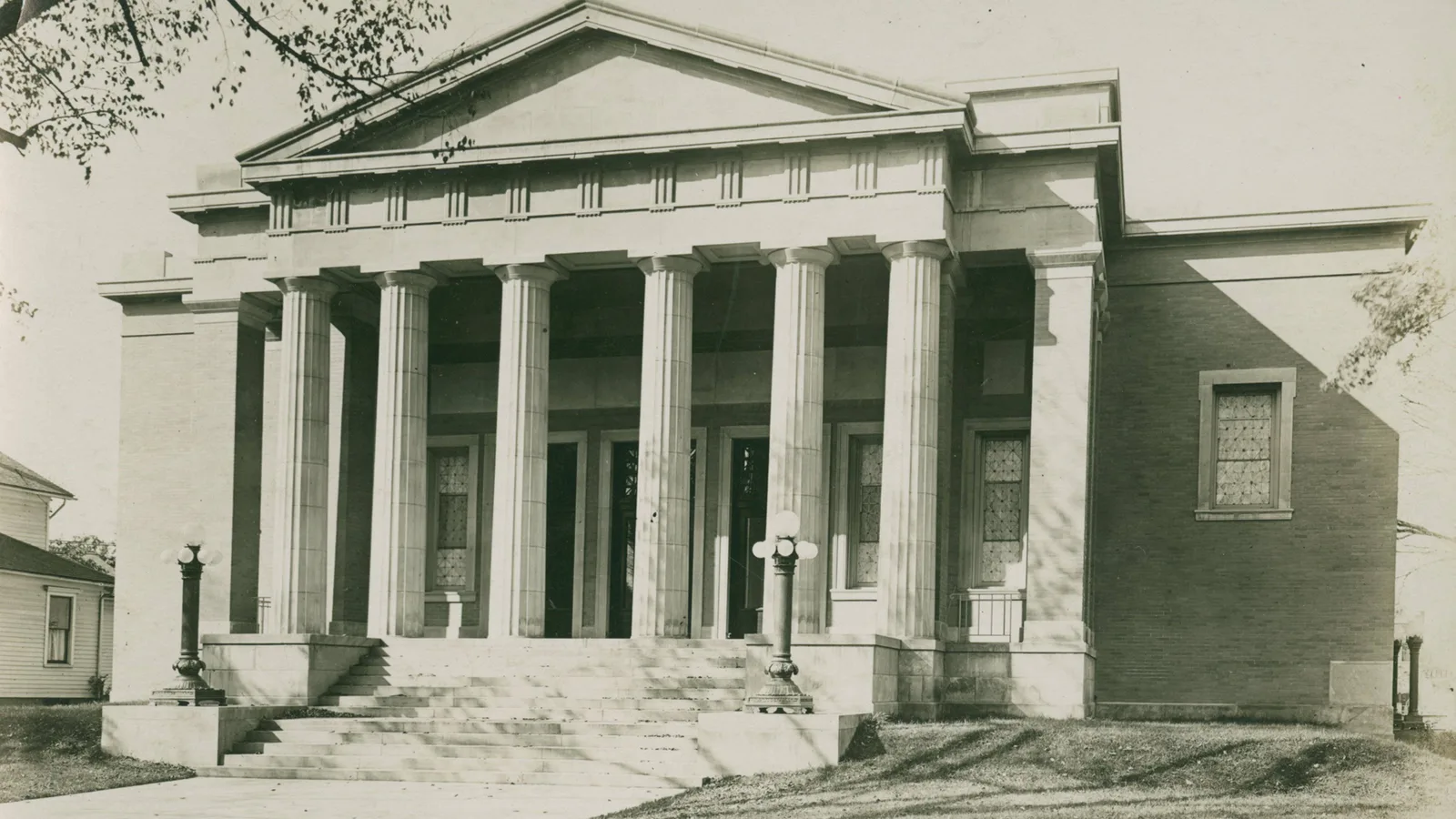
An early 20th-century view of an Evanston First Church of Christ, Scientist on Chicago Avenue. Photo: Sloan, Percy H. (Percy Haydn), 1867- / Wikimedia Commons, Public domain
The Music Institute of Chicago has Chicago in its name, but its central administration is in Evanston, and so is one of its best-known stages. For a school that began in 1931, that is a long run of teaching children and adults to play.
How it started
The school was founded in 1931 by David and Dorothy Dushkin and was originally called the Music Center of the North Shore. It later merged with two other community schools, the Music Arts School and the Lake Forest Symphony School. It operates as a nonprofit.
Lessons and classes
The institute’s website describes six Chicagoland campuses: two in Chicago, plus Evanston, Hinsdale, Lake Forest and Winnetka. It lists more than 130 teachers and over 1,900 students, with about 30 instruments taught across many styles.
- Private lessons and group classes
- Early childhood classes for ages 0 to 5
- Suzuki instruction and chamber music for ages 8 and up and for adults at intermediate or advanced levels
- Jazz studies, a Roots & Rock program, adult studies, summer camps and the MIC Chorale, which the site says is celebrating its 40th year
Financial aid is available. The institute also runs the Academy, a pre-college conservatory for advanced young musicians that is known for training string players and pianists.
Nichols Concert Hall
The Evanston campus is tied to Nichols Concert Hall at 1490 Chicago Ave. The building began as the First Church of Christ, Scientist, designed in 1912 by architect Solon S. Beman. A 2003 restoration converted it into a 550-seat concert hall and music education venue. Its restored 1914 E. M. Skinner pipe organ helped the project win the Richard H. Driehaus Award for best adaptive use from the Landmarks Preservation Council of Illinois, according to the institute.
The institute says about 15,000 people attend concerts, classes and events at the hall each year. It announced plans for a capital restoration of the hall in October 2017.
The lower level of the building holds the instruction side of the operation. The Evanston campus offers lessons in classical instruments and voice, so the same address serves students in a practice room one floor below a hall where recitals are staged. That mix is the school’s selling point for families who want lessons and a real performance space in one place.
Role in local arts education
Community music schools fill a gap that school band and orchestra programs cannot always cover: one-on-one teaching, a choice of instruments, and a path that runs from early childhood classes to conservatory-level training. The Music Institute’s range reflects that. Its early childhood classes cover ages 0 to 5, its Academy serves advanced pre-college players, and its adult programs and the MIC Chorale keep older students involved. Group classes, music theory, chamber music and performance opportunities round out its offerings, and its endowment stood at $3.5 million as of June 30, 2011, a figure that is now well out of date.
Other recurring events
The Chicago Duo Piano Festival, founded in 1988, is listed for July 12 to 19, 2026, with concerts, master classes and student recitals. A Fall Festival on Nov. 15, 2026, at 1 p.m., is an all-school event whose proceeds support scholarships and financial aid.
For Evanston families, the practical appeal is simple. A child can start lessons close to downtown, move into chamber music, and perform on a stage in town. Adults can enroll too, through the institute’s adult programs.
Rachel Lindqvist covers community life, the lakefront, dining and the arts for The Evanston Edge.