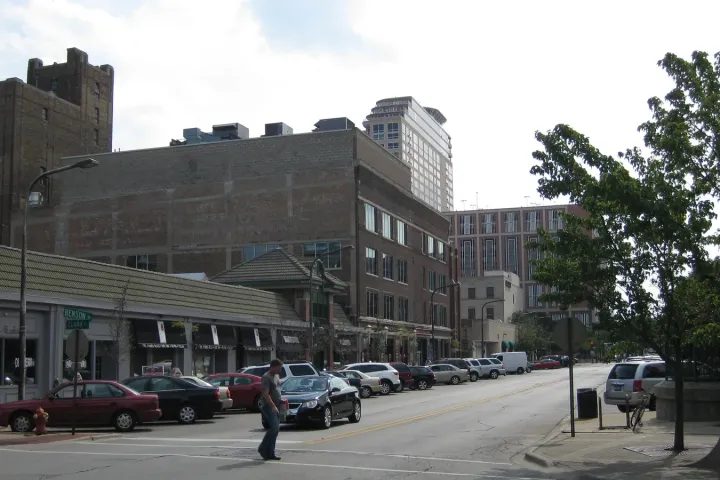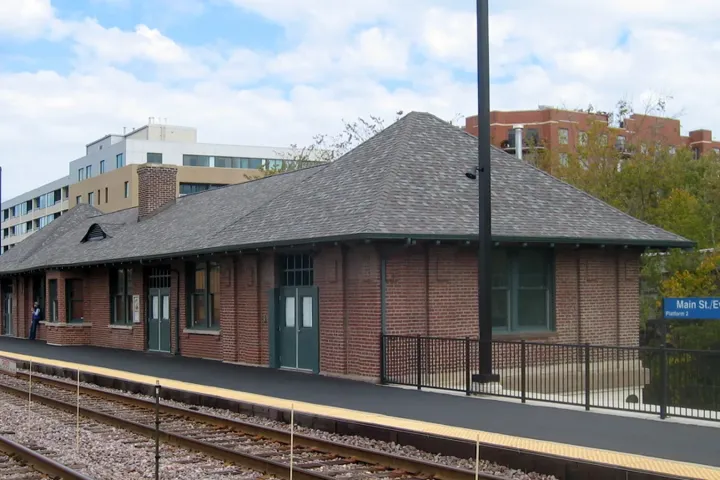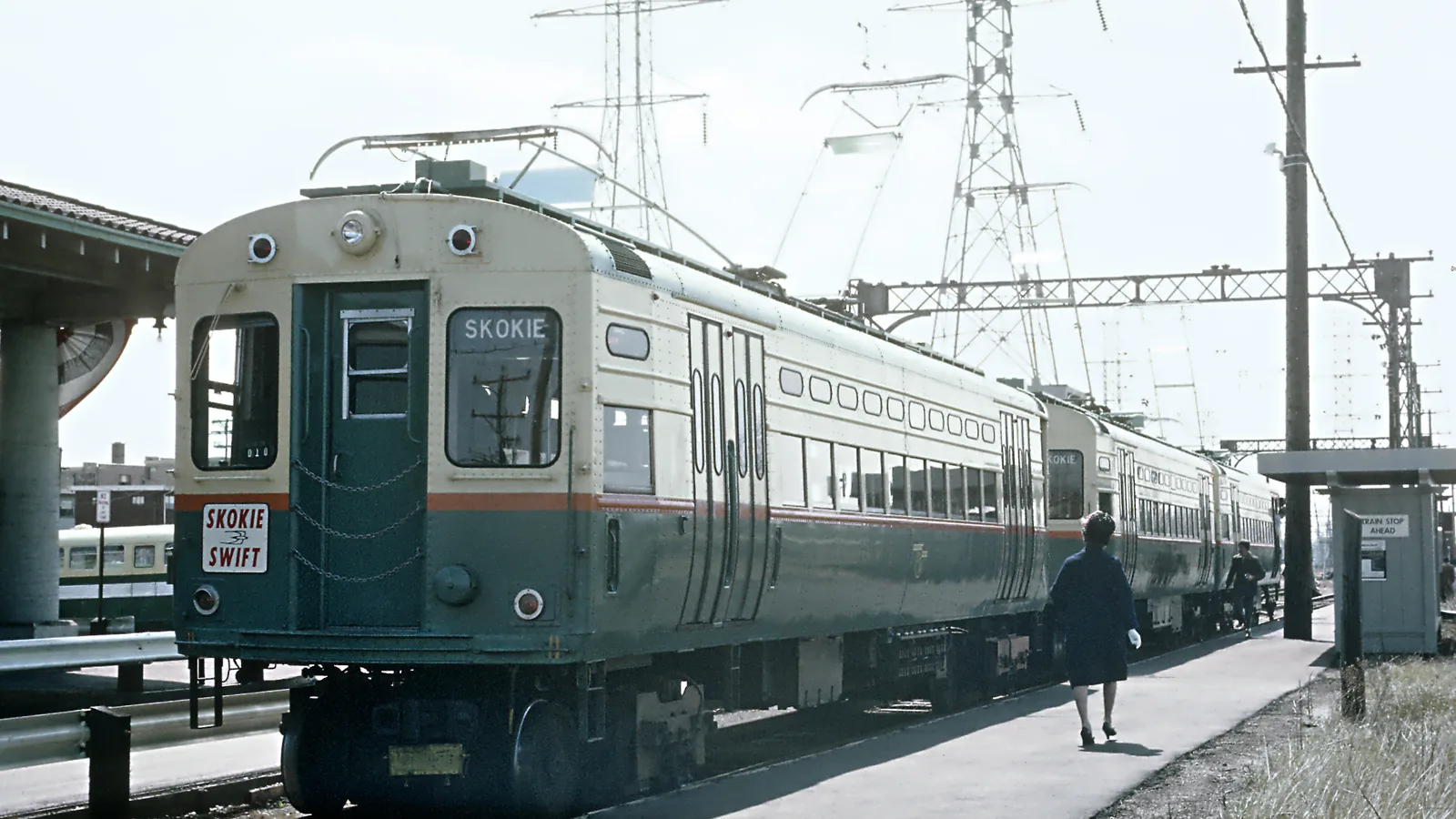
Skokie Swift cars at the Dempster Street terminal in Skokie, May 1964 Photo: railfan 44 / Wikimedia Commons, Public domain
For nearly half a century, a commuter could board an electric train in Evanston and ride to downtown Milwaukee without changing to a steam locomotive. The Chicago North Shore and Milwaukee Railroad, known as the North Shore Line, ran from July 16, 1916, to Jan. 21, 1963. It was a business first, built to carry passengers and freight at a profit, and its story is a case study in how a transportation company can lose its market.
How the railroad was put together
The roots were small. A streetcar company began service in Waukegan in 1895, and in 1898 the Chicago and Milwaukee Electric Railroad was incorporated to take over the line. Through service reached Church Street in Evanston in August 1899. The tracks pushed north into Wisconsin over the next several years, reaching Kenosha in December 1905, Racine in September 1906 and Milwaukee by October 1908. A receivership followed the Panic of 1907.
The utility magnate Samuel Insull put money into the property, and the North Shore Line took over operations in 1916. By the mid-1950s it covered 88.9 route miles between the Chicago Loop and Milwaukee, plus a branch from Lake Bluff to Mundelein. Trains used overhead wire and, on Chicago’s elevated tracks, third rail.
The Evanston end mattered to the economics. The company negotiated direct access to Chicago in 1919, using about four miles of its own Evanston Line from Linden Avenue in Wilmette to Howard Street, then trackage rights over the elevated system. A bypass through the Skokie River valley, built from 1924 to 1926, gave the railroad a faster alternative to the Shore Line route that ran through the lakefront suburbs.
Fast trains, hard decades
The railroad sold speed. The Electroliners entered service in February 1941 and could reach 90 mph between Dempster Street and North Chicago Junction. World War II filled the trains, thanks in part to Fort Sheridan and the Great Lakes Naval Training Station.
The decline began soon after. The company entered receivership in 1932 as Insull’s empire collapsed, and a strike over a 15 percent wage cut stopped service for seven weeks in 1938. A 91-day work stoppage followed in 1948. Waukegan’s streetcars were replaced by buses in 1947. In 1953 the railroad sold the Leland Avenue to Linden Avenue right of way to the Chicago Transit Authority for $7 million in revenue bonds. The Edens Expressway, which opened in late 1951, cut into ridership, and passenger service on the Shore Line ended July 24, 1955.
In 1958 the railroad asked to abandon all service. A federal examiner recommended abandonment, while Illinois regulators favored continued operation. Rail service ended Jan. 21, 1963.
What remains
The best-known survivor is the Skokie Swift. The Chicago Transit Authority launched it April 20, 1964, as a federally aided demonstration project, with the federal housing agency, the CTA and the Village of Skokie sharing net costs. It runs on part of the old Skokie Valley route, from Howard Street through southern Evanston to Dempster Street in Skokie, with one stop at Oakton Street. Now called the Yellow Line, it is about 4.7 miles long. It is also the least-used rail route on the CTA, averaging 1,240 weekday boardings, based on 2023 and 2024 figures.
The Dempster Street station in Skokie is on the National Register of Historic Places. Some North Shore Line cars are preserved in railroad museums, and the Electroliners were sold to a Philadelphia-area operator, renamed Liberty Liners and ran on the Norristown High Speed Line until about 1979.
Add The Evanston Edge as a preferred source on Google (opens in a new tab)