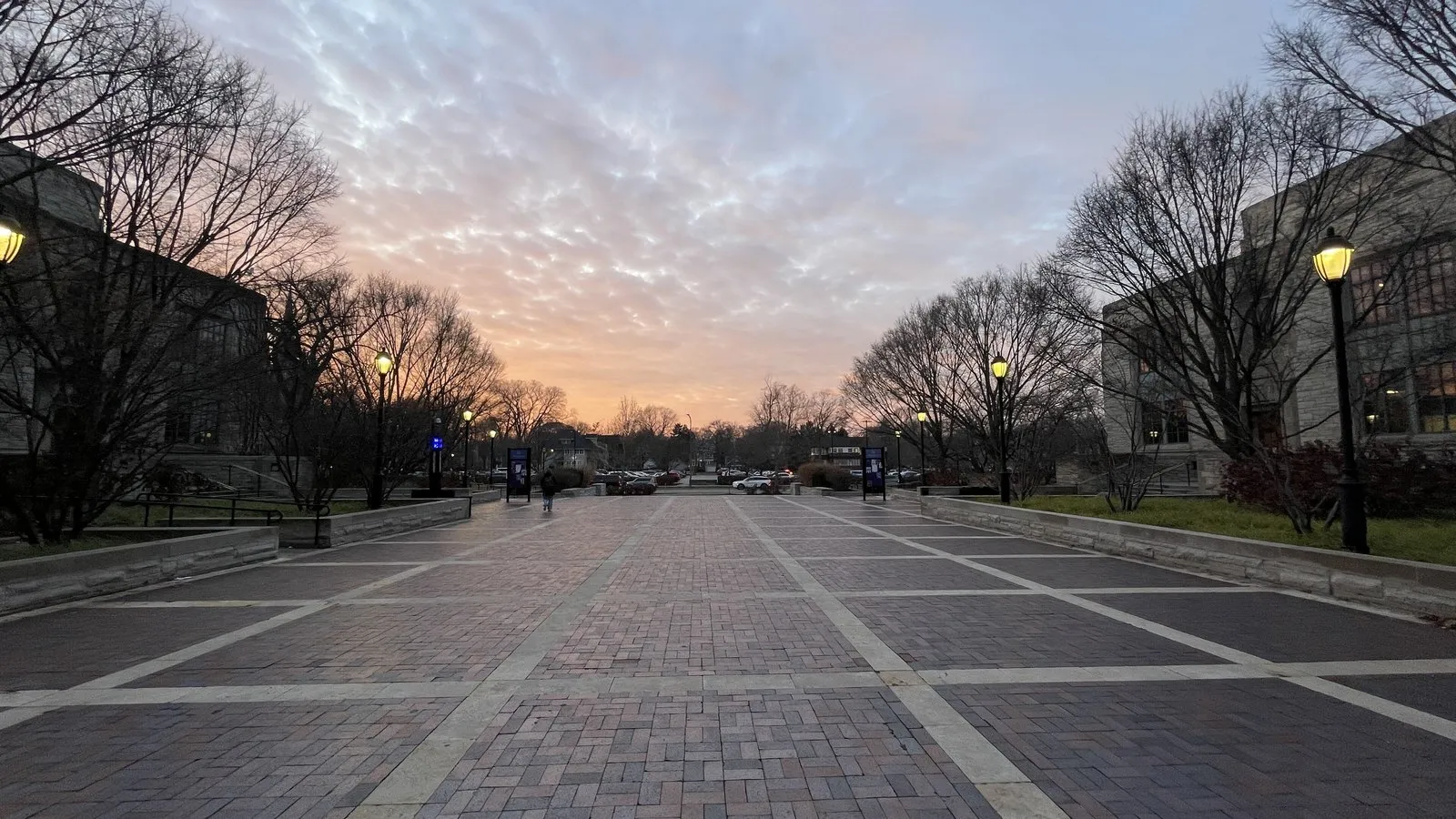
Northwestern's Technological Institute in Evanston, home of the McCormick School of Engineering. Photo: Horizon Ruler / Wikimedia Commons, CC BY-SA 4.0
During last week’s SC26 conference, a fiber line running from Northwestern’s Chicago campus to McCormick Place carried two kinds of traffic at once: the ordinary internet data serving a computing conference, and single particles of light that were quantum-entangled with partners in a lab on the Evanston campus.
Northwestern engineers led by Prem Kumar set up the three-site quantum networking demonstration for SC26, the international supercomputing conference held Nov. 15-20 at McCormick Place. The university’s McCormick School of Engineering reported Nov. 19 that the experiment succeeded, distributing entangled photons across about 35 kilometers of fiber that was already in use.
Kumar chairs Northwestern’s electrical and computer engineering department and directs its Center for Photonic Communication and Computing, based in the Technological Institute on Sheridan Road.
A source in the middle, two sites at the ends
Entanglement links particles so that measurements on one are correlated with measurements on the other in ways classical physics can’t explain. Sharing entangled photons between distant sites is a basic building block for moving quantum information, and eventually for connecting quantum computers in different places.
The setup used a source of entangled photon pairs mounted in an equipment rack at StarLight, the communications exchange on Northwestern’s Chicago campus, and controlled remotely. For each pair, one photon traveled about 24.5 kilometers north to Kumar’s lab in Evanston. The other went about 10 kilometers south to McCormick Place.
That arrangement let two distant sites share entanglement without either one producing the photon pairs itself. Both routes ran on fiber that also carried conventional telecommunications traffic, and the McCormick Place leg carried live conference data for real users.
“If quantum signals can share the fiber that already carries internet traffic, we can expand quantum networks without the expense of building a separate fiber network,” Kumar said in the school’s announcement. “By testing that approach across three sites, we hope to learn how to connect more sites and, eventually, link quantum processors in different locations so they can work together.”
Building on an Evanston-to-downtown link
The demonstration grew out of an experiment the team ran in summer 2025 and published in the journal Optica Quantum in July. That test sent entanglement over 24.4 kilometers of installed fiber between Evanston and downtown Chicago while the same fiber carried high-capacity telecom signals. One photon from each pair stayed in Evanston and the other traveled to StarLight.
The researchers measured entanglement fidelity above 94% in that test, meaning the shared quantum state largely survived the trip. That experiment used generated test data on the fiber. The SC26 run used real traffic.
Ciena, the networking equipment company, supplied gear that expands the conventional signals from the C band used in the earlier experiment into both the C and L bands of the optical spectrum. Kumar expects that to roughly double the classical capacity of the earlier configuration.
Keeping time across the city
The hard part of a three-site network is timing. Researchers have to match up detections of photons from the same pair even though the two photons travel routes of different lengths. The system has to keep one reference clock and two remote clocks aligned to within a few trillionths of a second.
The team plans to expand its use of White Rabbit, a synchronization technology developed at CERN, and an industry partner has loaned timing equipment. The photons carry their entanglement in polarization, the orientation of the light’s electric field, which drifts as conditions along the fiber change. The lab’s Quantum Wrapper approach uses conventional optical signals traveling with the quantum ones to monitor and correct that drift automatically.
Students are building and integrating much of the system. “We are working to bring Northwestern’s quantum network out of the laboratory and into the real world,” said Gina Talcott, the lead graduate student on the project in Kumar’s lab.
Next stop: Argonne
Software from Argonne National Laboratory, developed through the U.S. Department of Energy-funded InterQnet collaboration, is meant to coordinate the network so it can run continuously with less hands-on work.
Kumar and his collaborators said that if the conference demonstration went as planned, they would attempt to distribute entanglement between Northwestern and Argonne immediately afterward. That would be a longer route, and a connection the group first proposed in 2019 as part of the Illinois Express Quantum Network.
The work adds to a busy month for the engineering school, which recently announced more than $145 million in gifts. Chicago’s quantum push has also drawn industry, including the IBM quantum computer unveiled in Chicago this month. Closer to home, City Council’s final 2027 budget vote was scheduled for Monday night.
Add The Evanston Edge as a preferred source on Google (opens in a new tab)