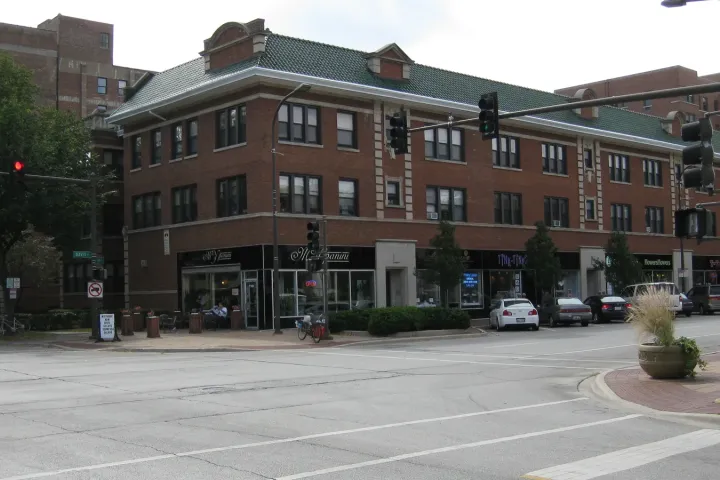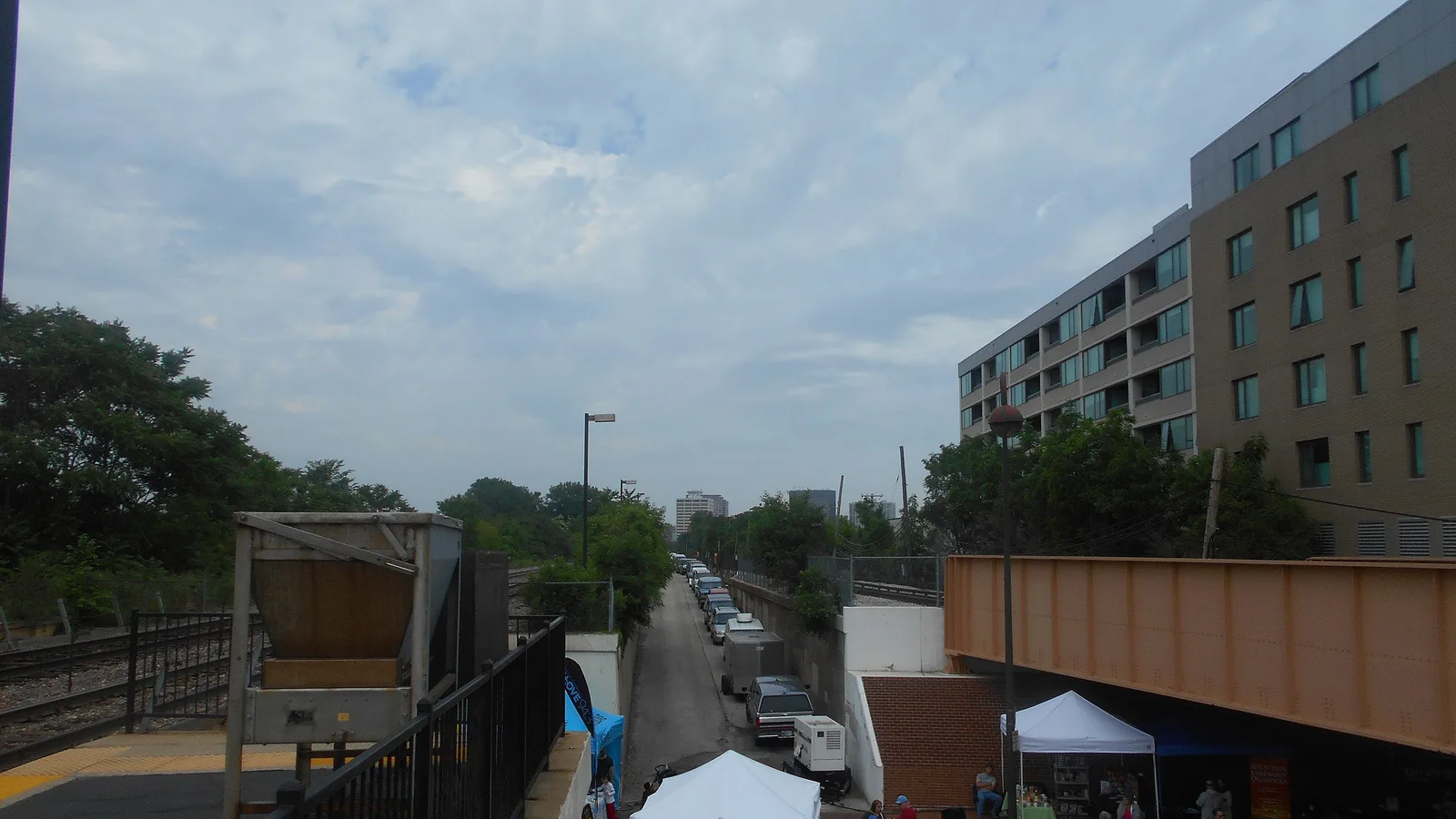
The Main Street station area in Evanston. Photo: Adam Moss from Tonawanda, New York, United States / Wikimedia Commons, CC BY-SA 2.0
Architect Andrew J. Spatz, 62, has spent nearly two decades building live/work space in Evanston, and in April 2013 he said he planned to keep going. He described a ten-year pipeline of adaptive-reuse and new-construction projects, starting with a demolition set for June at 1629 Oak St.
Spatz earned a master’s degree in architecture from Tulane University and worked for years on a conventional fee-for-service design/build basis. By his account, that arrangement left him with a modest fee at the end of each job while the lasting value of the building went to the client. In 1994 he and partner Signe V. Adas started Adas/Spatz Properties, which designs, builds, owns and manages its own buildings. Every one of them is in Evanston. The architecture side operates as Berry/Spatz Architects, with partner Matt Berry.
Metal, concrete and mixed-use floors
The firm’s best-known work is the pair of METALHouse buildings at 1220 and 1216 Main St., whose bold sculptural forms sit on a block of ranch houses and Victorians. Others include the STAMPFactory at 1616-20 Payne St. and 2119-23 Dewey Ave., the Cinema and shopStudios buildings on Pitner Avenue, Christ Temple M.B. Church at 1711 Simpson St., and AFZ+3 at 604-606 Davis St., where shops occupy the ground floor and three live/work units sit above. Spatz said the Davis Street building and the others were built within existing zoning and building codes, with no variances.
The firm works out of a below-grade studio at METALHouse 2. On the kitchen counter upstairs, Spatz keeps 14 plug-in clocks dating from 1925 to 1955.
A small, local portfolio
Spatz said he owns 11 buildings with 58 rental units and can pull up profit and loss on each. He said none were vacant in spring 2013. His rents, he said, ran as much as half below comparable downtown office space, helped by buying materials from local suppliers and avoiding long freight hauls that he put at up to 20 percent of material costs. The company collects rent and handles maintenance itself, and Spatz said he sees about half his tenants every month and the rest at least every other month.
The Oak Street project is a four-unit live/work building, still unnamed in April, with first occupants expected about a year after demolition. Spatz said its design emphasizes green engineering aimed at lowering energy and maintenance costs.
Spatz is also an avid bicycle racer. After several cautious years, he said, he and Berry were ready to take on more risk as the economy recovered.
Architizer describes Berry/Spatz as a two-person design/build firm working with its sister property division, Adas/Spatz Properties.
Daniel Okafor covers business, startups and the Innovators section for The Evanston Edge.