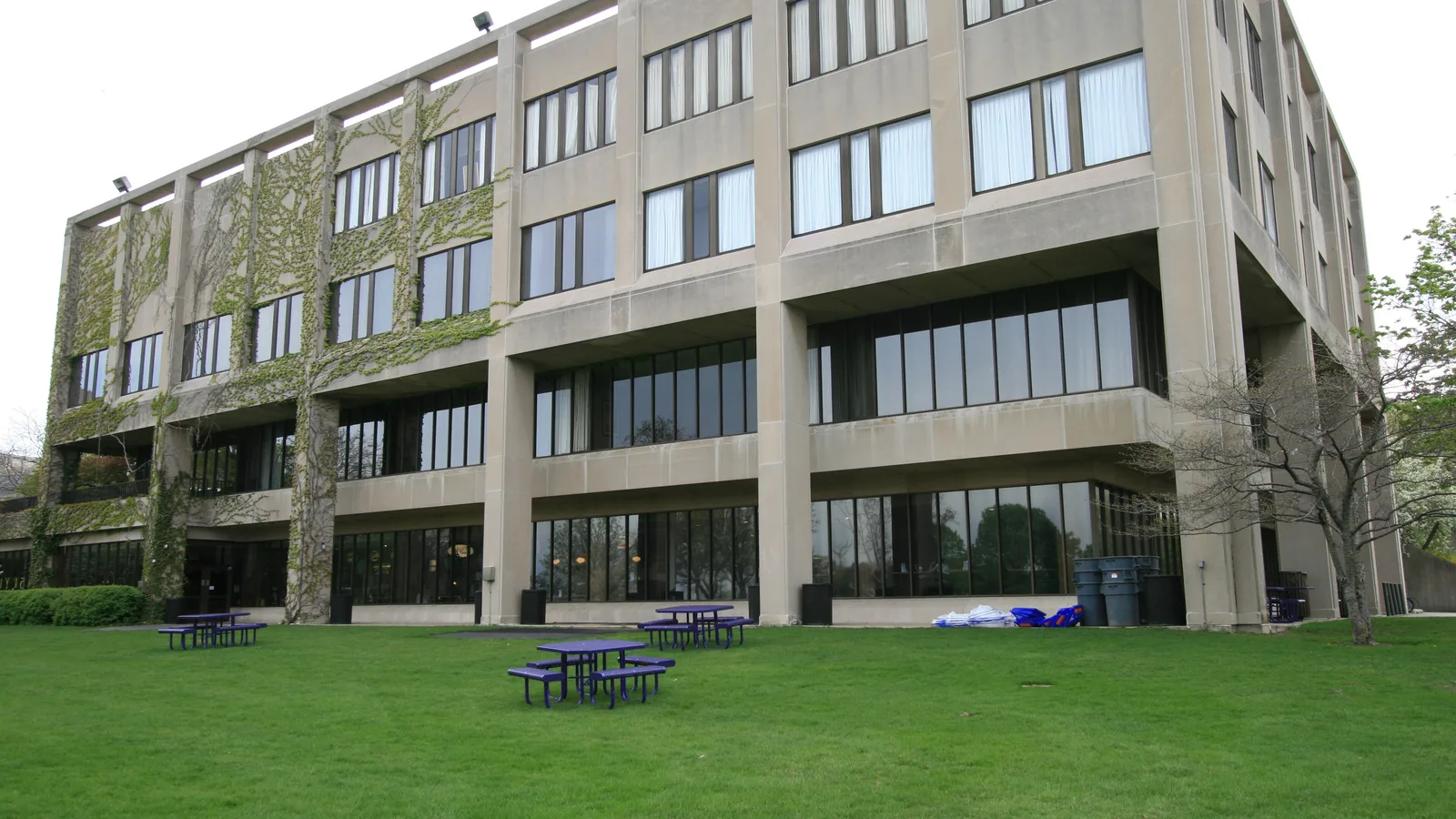
Norris University Center on the Northwestern campus in Evanston, the site of WildHacks. Photo: Madcoverboy (talk) / Wikimedia Commons, CC BY-SA 3.0
A project that lets cyclists signal turns with a wave of the arm took first place at WildHacks, the 24-hour hackathon Northwestern University held on its Evanston campus on Nov. 22 and 23, 2014.
The winner, BikeSight, was built by Northwestern student Michael Wang. It pairs a Myo gesture-sensing armband with a bicycle helmet fitted with light-up icons. Hand movements trigger the lights, so a rider can signal without taking a hand off the bars for long.
How it worked
A hackathon puts developers, designers and other makers in a room for a fixed stretch, in this case 24 hours, to build something from scratch. At the end, teams demonstrate their work to judges. WildHacks was free to attend and had no required theme. Judges scored entries on originality, technical difficulty, design and usefulness.
Northwestern’s McCormick School of Engineering reported that 413 college students registered from across the country, 130 of them from Northwestern. Visitors came from Purdue, the University of Wisconsin, the University of Michigan and the University of Illinois at Urbana-Champaign, and one team traveled from Johns Hopkins. They submitted 86 projects across web, desktop and mobile platforms.
The event was held at the Norris University Center and was run by EPIC, an entrepreneurship student group supported by the Farley Center for Entrepreneurship and Innovation, together with HackNorthwestern. Sponsors included Ford and IBM, and Major League Hacking sent staff to mentor teams and troubleshoot. Several McCormick alumni in California also volunteered as mentors.
Other winners
Second place went to Regex Adventures, an interactive online game that teaches a computer language. The project came from Northwestern students Nathan Yeazel, Daniel Rasmuson and Alex Kowalczuk.
Third place went to Marty Kausas of Purdue for WaveWatcher, a watch face for the Pebble smartwatch that displays tide information for nearby beaches.
The Daily Northwestern described the weekend as the university’s first intercollegiate hackathon, and it came with cash prizes of up to $2,000 plus sponsor awards such as Chromebooks. The event drew students of all majors, though most participants came from computer science.
Hackathons like this have become a regular feature of campus life across the Midwest. They give students a low-stakes place to try product ideas, and for Northwestern’s entrepreneurial community, a path to connect with sponsors and with peers from other schools.
Daniel Okafor covers business, startups and the Innovators section for The Evanston Edge.