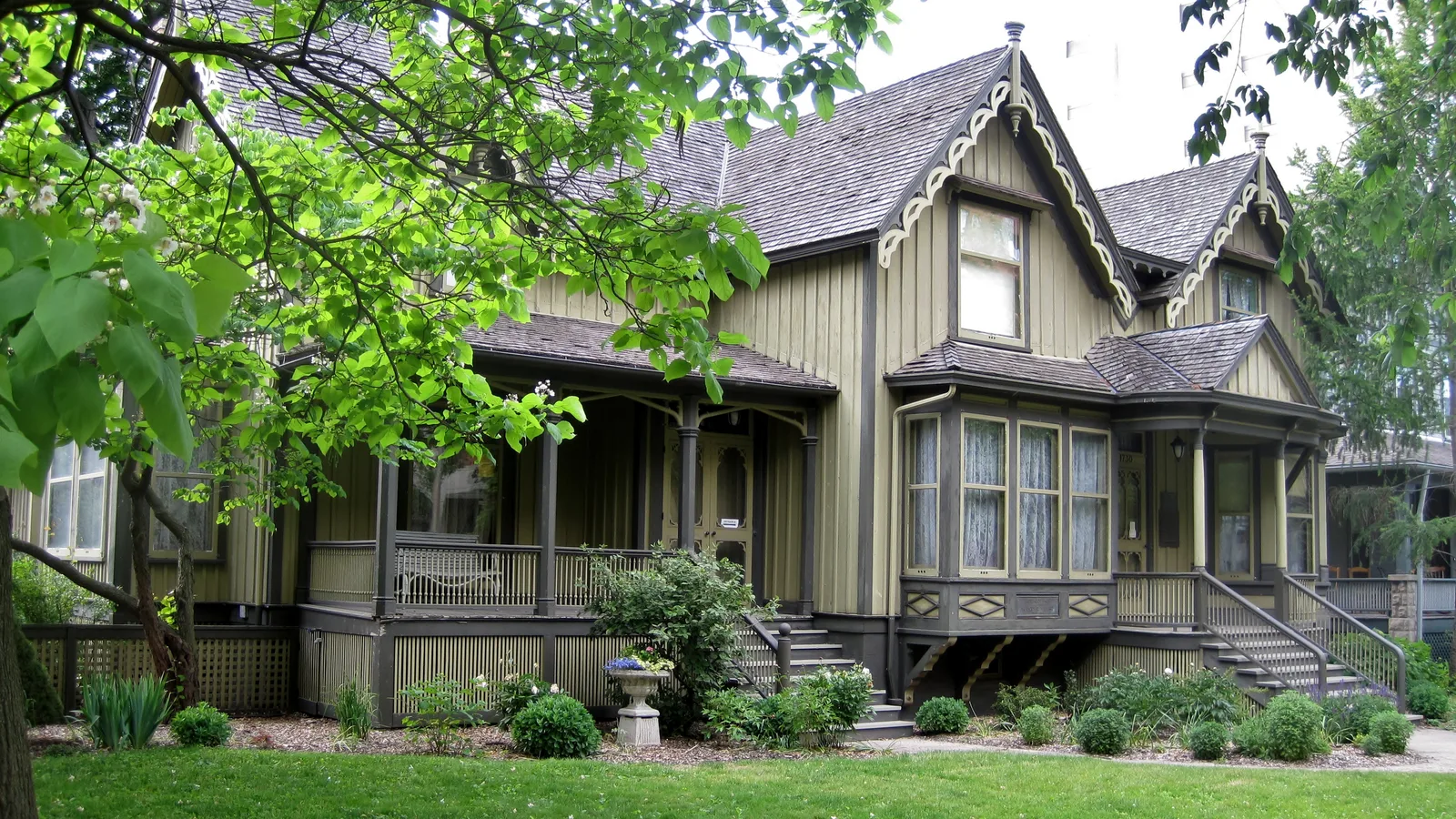
The Frances Willard House, which Willard called Rest Cottage, on Chicago Avenue in Evanston. Photo: Teemu008 from Palatine, Illinois / Wikimedia Commons, CC BY-SA 2.0
Frances Willard led one of the largest women’s organizations of the 19th century, and her home base was a gray Carpenter Gothic house at 1730 Chicago Ave. in Evanston. She called it Rest Cottage. It is now a museum and a National Historic Landmark.
From Evanston student to college president
Willard was born Sept. 28, 1839, in Churchville, New York. Her family moved to Evanston in 1858. In 1871 she became president of the newly founded Evanston College for Ladies. When it became the Woman’s College of Northwestern University in 1873, she was named the university’s first Dean of Women. She resigned in 1874 after conflicts with University President Charles Henry Fowler over how the Woman’s College was governed.
The organizing method
The Woman’s Christian Temperance Union was organized in Ohio in 1873 and formally declared at a Cleveland convention in 1874. Willard took part in that founding convention and became its corresponding secretary. On Oct. 31, 1879, she was elected national president, a post she held until her death.
Her central move was to widen the agenda. The “Do Everything” approach pushed members into prohibition, woman suffrage, education reform and labor conditions. Temperance was an entry point for women who had few other organized public roles. Once inside, they could work on other causes.
She tied suffrage to the cause members already cared about. Her “Home Protection” argument held that women needed the ballot to protect their homes from the harms of legalized liquor, and she published a Home Protection Manual in 1879. The framing let temperance-minded women who might have balked at a plain suffrage appeal support the vote.
She also built outward. She founded the World’s WCTU in 1888 and became its president in 1893. From 1888 to 1890 she served as first president of the National Council of Women of the United States. In 1883 she circulated the Polyglot Petition against the international drug trade. In 1895 she published a book about learning to ride a bicycle, A Wheel Within a Wheel.
Scale and legacy
The WCTU had more than 766,000 dues-paying members at its 1927 peak, nearly three decades after Willard died on Feb. 17, 1898. The national headquarters has been in Evanston since 1910. The organization shifted its focus toward prohibition in 1893 and supported the Eighteenth Amendment; membership declined after Prohibition took effect.
Willard’s statue, by Helen Farnsworth Mears, was unveiled in 1905 in the U.S. Capitol’s National Statuary Hall. A U.S. postage stamp honored her on March 28, 1940, and she was inducted into the National Women’s Hall of Fame in 2000.
The house dates to 1865, when her father, Josiah Willard, built it. The southern part of that original structure remains in the two-story, 17-room building. She left it to the WCTU, which opened it as a museum in 1900. It was designated a National Historic Landmark on June 23, 1965, and the national WCTU owns it. Public tours are listed on the first and third Sundays of each month; check with the museum for current hours.
Thomas Brennan covers property taxes, real estate, transit and the local economy for The Evanston Edge.