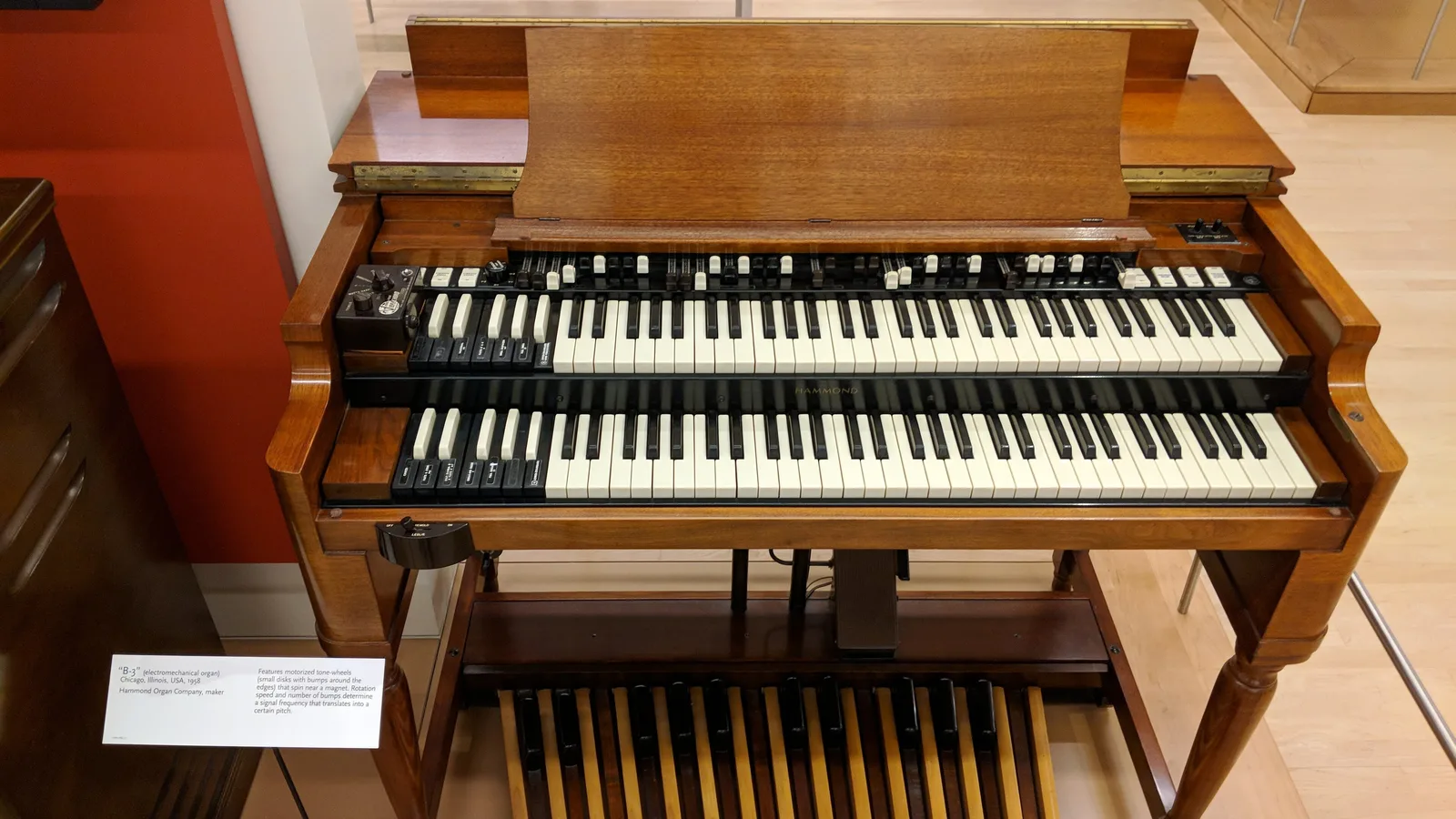
A 1958 Hammond B-3 tonewheel organ on display at the Musical Instrument Museum in Phoenix. Photo: bobistraveling / Wikimedia Commons, CC BY 2.0
Laurens Hammond was born in Evanston on Jan. 11, 1895, and spent a long career building things that were clever, practical and not always commercial. The one that stuck, the Hammond organ, grew out of a clock company, a used piano and a Depression-era patent office.
An Evanston childhood interrupted
Hammond’s father died in January 1897, and his mother, an artist, took the family to France. They lived for about 11 years in France and Germany before returning to Evanston in 1909, when Hammond was 14 and fluent in French and German. While still in Europe he designed an automatic transmission for cars, which Renault’s engineers did not accept. His first patent came in 1912, for a barometer meant to sell for a dollar.
He studied mechanical engineering at Cornell, graduating with honors in 1916, and served in World War I with the 16th Regiment Engineers (Railway) of the American Expeditionary Force, rising to captain. Afterward he worked as chief engineer at the Gray Motor Company, a Detroit marine engine maker.
Clocks, 3-D movies and a card table
In 1919 he invented a silent spring-driven clock, and its success let him open his own workspace in New York. In December 1922 his Teleview system, a shutter-glass setup for 3-D film, debuted with The Man from M.A.R.S. at the Selwyn Theatre. Critics liked it, but outfitting theaters was too expensive, and the process was not used again.
His work on synchronous electric motors led to the Hammond Clock Company, founded in Chicago in 1928 with six workers above a grocery store. The firm also sold an electric bridge table priced at $25, with a mechanism under the surface that shuffled the cards and dealt them to four players.
From a piano keyboard to a tonewheel generator
In 1933, Hammond bought a used piano, kept only the keyboard action and used it as a test controller while he tried different ways of making sound. He settled on a tonewheel generator, in which motor-driven wheels turn near magnets and each produces an electrical signal at a set pitch. The keys decide which of those signals reach the output.
The company’s assistant treasurer, W. L. Lahey, was organist at St. Christopher’s Episcopal Church and advised Hammond on how the instrument should sound. Hammond filed his patent application on Jan. 19, 1934. Because it was the Great Depression, the Patent Office expedited the application to help create jobs, and U.S. Patent 1,956,350 was issued on April 24, 1934. The Hammond Organ went into production in 1935.
The engineering thread runs straight back to the clock business: synchronous motors and spinning parts, rather than pipes, did the work of making notes. Contemporary price comparisons with pipe organs are beyond what the sources for this profile document, so none are made here.
Later work and recognition
Hammond is also credited with the Novachord, described as the first polyphonic synthesizer. In 1940 the Franklin Institute gave him its John Price Wetherill Medal for the electric organ. He left the company presidency in 1955 and retired in 1960. He held 91 patents over his lifetime and died in Cornwall, Connecticut, on July 1, 1973, at age 78. In 2017 the Laurens Hammond Museum opened in Kielce, Poland.
Daniel Okafor covers business, startups and the Innovators section for The Evanston Edge.