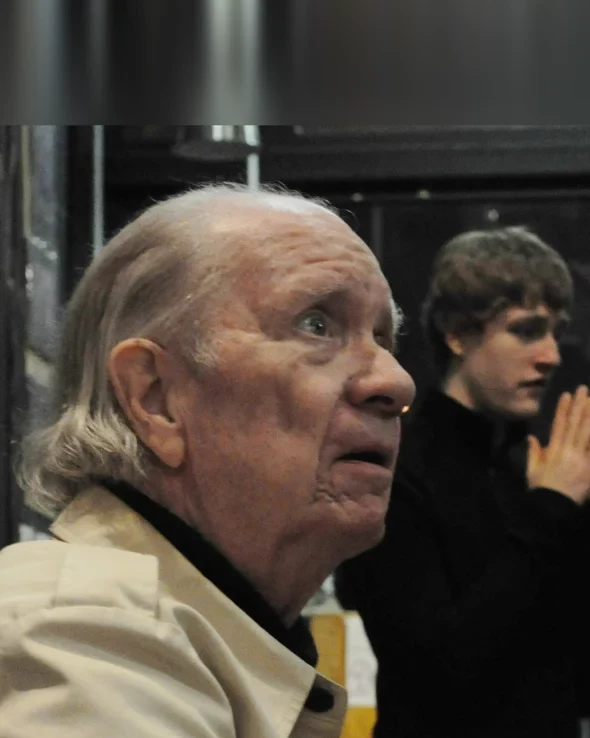
Gahan Wilson signing books at a Seattle bookstore. Photo: Joe Mabel / Wikimedia Commons, CC BY-SA 3.0
A man in a trench coat stands at a door while something with too many teeth waits politely on the other side. Readers of Playboy and The New Yorker spent decades looking at scenes like that one, drawn by a cartoonist who grew up on the streets of Evanston.
Gahan Wilson was born in Evanston in 1930, according to a profile in the East Hampton Star. (Sources disagree on the exact birth date, with most citing Feb. 18 and one interview giving Oct. 18.) His father was an executive at Acme Steel, and both of his parents were amateur artists. Wilson said he knew from early on that he wanted to draw.
A used copy of Punch and a drugstore comics rack
In an interview with The Comics Journal, Wilson recalled finding a bound volume of the British humor magazine Punch in a secondhand store when he was eight or nine. It cost 15 cents. His father later bought the full set. Wilson credited the magazine’s artists, including Honoré Daumier and George Cruikshank, with pointing him toward cross-hatching, the dense web of fine lines that became part of his look.
Other Evanston details surface in accounts of his youth. He has described reading comics at the Evanshire Drug Store, and he drew a school comic strip called Drippy Dan the Detective. Later influences, by his own account, included Francisco Goya, Hammer horror films, and paintings he saw at the Art Institute of Chicago. He also cited the satirical cartoons of Mad and 1950s science fiction films.
He spent one year at a conventional high school before transferring to the Todd School for Boys in Woodstock, Illinois. He went on to earn a bachelor of fine arts from the School of the Art Institute of Chicago, and the school gave him an honorary doctorate of fine arts in 2012.
New York, Playboy and a long run
After college Wilson moved to New York, started with small magazines and was soon supporting himself with cartoons. His first Playboy cartoon ran in December 1957, and he kept contributing for about 50 years. Fantagraphics collected that body of work in a three-volume slipcased set, Gahan Wilson: 50 Years of Playboy Cartoons, in 2009.
His work also appeared in Collier’s and The New Yorker, and he was a regular in National Lampoon. He wrote film reviews and cartoons for The Magazine of Fantasy & Science Fiction, reviewed movies for The Twilight Zone Magazine and served as a book critic for Realms of Fantasy. He illustrated Jerome Beatty Jr.’s Matthew Looney children’s books starting in 1961 and drew the cover art for the annual Passport to World Band Radio from 1992 until the series ended.
The style
The Comics Journal described his cartoons as known for black humor and bizarre, often grisly imagery. Wilson described his own method as starting from an everyday subject and drifting, almost in a trance, toward something strange. He said that if an idea did not make him laugh or scare him, it would not work for anyone else.
The joke in a Wilson cartoon usually sits inside an ordinary setting: a diner, a suburban living room, a doctor’s office. The monster is rarely the point. The point is how calmly everyone treats it.
His reach went beyond the page. He wrote and illustrated a story for Harlan Ellison’s 1972 anthology Again, Dangerous Visions and designed the H.P. Lovecraft bust trophy for the World Fantasy Award in 1975. The statuette was retired after the 2015 awards. He co-created a computer game, Gahan Wilson’s The Ultimate Haunted House, with Byron Preiss, and wrote a 1992 animated short, Diner. Gary Larson, John Callahan and Bill Plympton among the cartoonists he influenced.
Honors and later years
Wilson received the Bram Stoker Award for Lifetime Achievement in 1991 and the National Cartoonists Society’s Milton Caniff Lifetime Achievement Award in 2005. He also won World Fantasy lifetime recognition. A documentary about him, Gahan Wilson: Born Dead, Still Weird, was directed by Steven-Charles Jaffe.
Wilson was married to the author Nancy Winters from 1966 until her death in March 2019. He died in Scottsdale, Arizona, on Nov. 21, 2019, at age 89, of complications of dementia.
Evanston has produced its share of writers and performers. It is less often named as the place where one of American humor’s great chroniclers of the creepy first picked up a pencil, a copy of Punch in his lap.
Add The Evanston Edge as a preferred source on Google (opens in a new tab)
Thomas Brennan covers property taxes, real estate, transit and the local economy for The Evanston Edge.