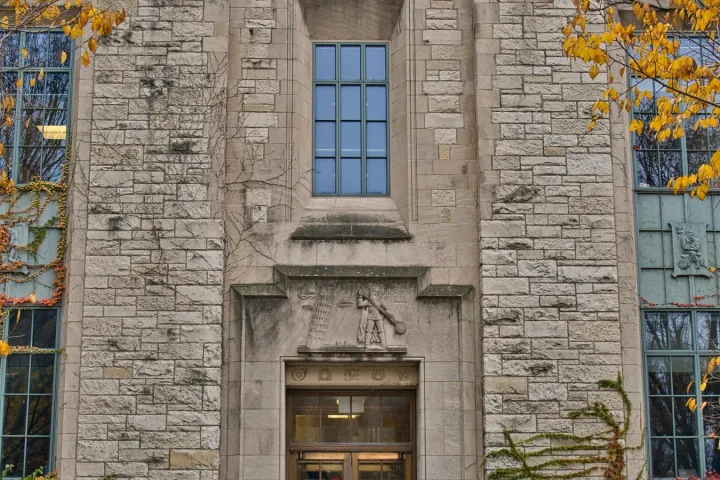
The Northwestern University observatory in Evanston. Photo: J. Crocker / Wikimedia Commons, Attribution
Most astronomers who were handed UFO reports in the 1940s wanted to explain them away. J. Allen Hynek started out the same way, and spent the next four decades arguing that the reports deserved better study.
From Yerkes to Evanston
Hynek was born in Chicago on May 1, 1910, to Czech parents. He earned a bachelor’s degree at the University of Chicago in 1931 and a Ph.D. in astrophysics at the university’s Yerkes Observatory in 1935. He taught at Ohio State from 1936, became a full professor there in 1950 and joined the Smithsonian Astrophysical Observatory in 1956. In 1960 he arrived at Northwestern University as professor and chair of the astronomy department, a post he held until retiring in 1978. The Daily Northwestern adds that he also directed the Dearborn Observatory on the Evanston campus and was known for a popular undergraduate course, Highlights of Astronomy.
The Air Force years
The Air Force first hired Hynek in 1948, while he was still at Ohio State. He served as scientific consultant through its successive UFO inquiries: Project Sign, Project Grudge and then Project Blue Book, which wound down in 1969. His job was largely to judge whether a given report had an astronomical explanation, such as a bright planet or a meteor.
His best-known public moment came in March 1966, after sightings near Dexter, Michigan. Hynek suggested swamp gas could account for some of them. He said it applied to only part of the reports, but the phrase was widely mocked, and it followed him for years.
Close encounters and a research center
He later developed a classification system for sightings, published in his first book, The UFO Experience, in 1972. A close encounter of the first kind is a sighting at close range, the second involves physical effects, and the third involves reported occupants. Steven Spielberg’s 1977 film Close Encounters of the Third Kind borrowed its title from the scale, and Hynek consulted on the picture and appears in a cameo near the end.
In 1973 he founded the Center for UFO Studies and served as its first head. The founding took place in Evanston, Illinois, and the organization is now based in Chicago; the Daily Northwestern describes it simply as a Chicago group. After his death, the center took his name and still operates as a library and research resource. Mark Rodeghier, whom Hynek named scientific director, described him to the Daily Northwestern in 2023 as an "old-school conservative scientist", and the center today takes no firm position on whether sightings involve extraterrestrials.
The Daily Northwestern also notes that Hynek used the Lindheimer Astronomical Research Center at Northwestern, built in 1966 and demolished in 1995, and that light pollution from Chicago and Evanston was one reason it came down. Sources differ on small points, such as the exact years of the Air Force projects, which is why this profile gives only the broad outline of that work.
Hynek died on April 27, 1986, at a hospital in Scottsdale, Arizona, of a malignant brain tumor. He was 75. His papers are held by Northwestern University Archives.
Add The Evanston Edge as a preferred source on Google (opens in a new tab)
Daniel Okafor covers business, startups and the Innovators section for The Evanston Edge.