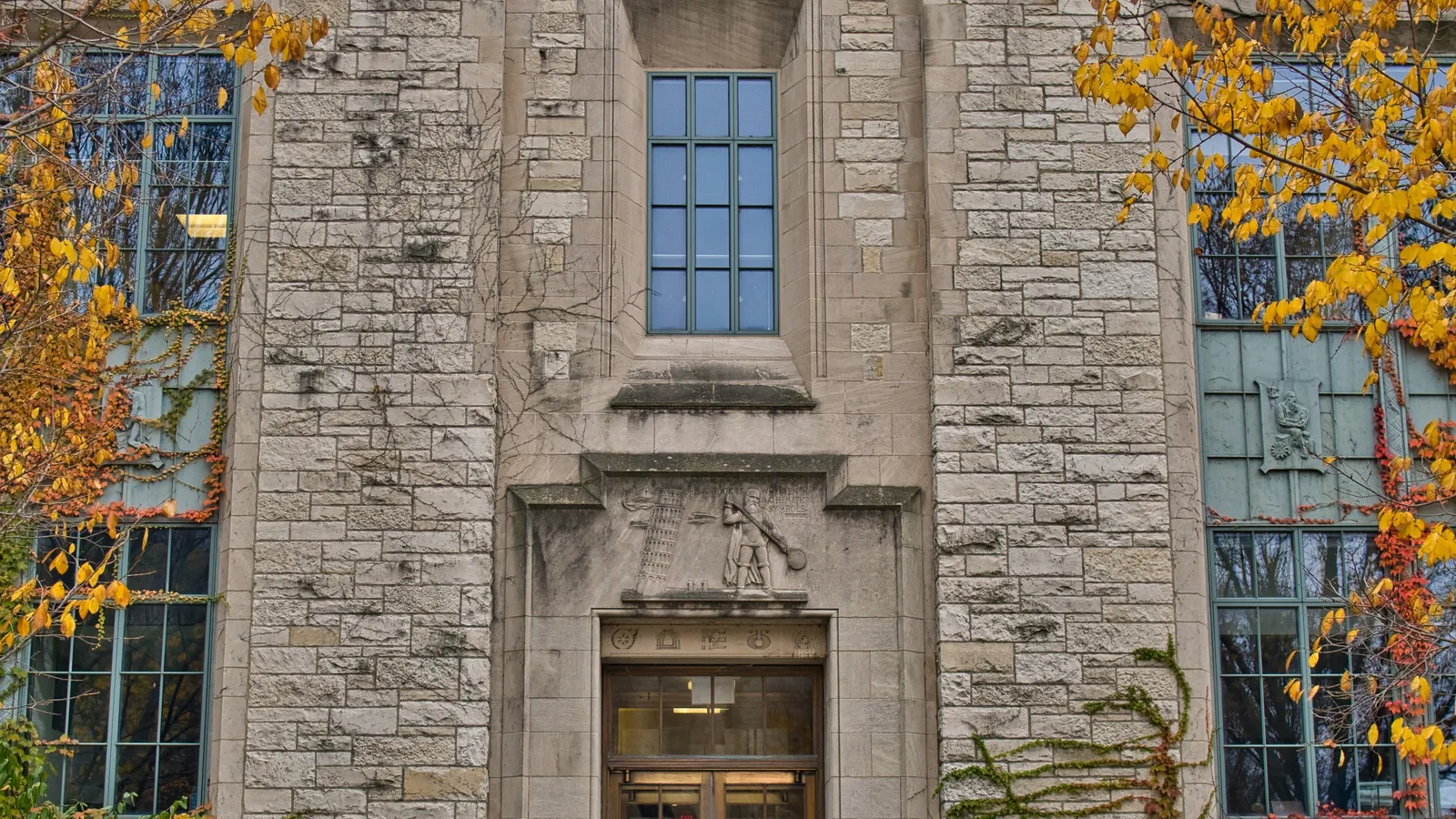
The Technological Institute on Northwestern's Evanston campus, home to the engineering school. Photo: Chris Rycroft from Madison, Wisconsin, United States / Wikimedia Commons, CC BY 2.0
Most drugs are molecules that bind to something. Samuel Stupp, a Northwestern University scientist, works on a different idea: molecules that build structures on their own, and that tell cells what to do once they are in place.
From Costa Rica to Northwestern
Stupp was born in San José, Costa Rica, in 1951 and came to the United States in 1968 to study at UCLA, where he earned a chemistry degree in 1972. He completed his Ph.D. at Northwestern in 1977, then began as an assistant professor there. After about three years he moved to the University of Illinois at Urbana-Champaign and returned to Northwestern in 1999 as a Board of Trustees Professor in materials science, chemistry and medicine.
Nanofibers that act like scaffolding
In 2001, Stupp and postdoctoral fellow Jeffrey Hartgerink reported a class of peptide amphiphiles, short molecules that assemble into nanoscale fibers. The fibers mimic the extracellular matrix, the web of material that surrounds cells in the body. Applications explored in his field include bone and cartilage regeneration, blood vessel growth, spinal cord injury and stem cell differentiation.
The best-known result came in 2021, when his group published a study in Science showing that an injectable therapy reversed paralysis in mice after severe spinal cord injury, as Northwestern describes it. The liquid gels on contact with tissue and stays at the injury site. Those were animal experiments, not a proven human treatment. In 2024, Northwestern also pointed to his group’s work on cartilage regeneration.
The business side
The peptide amphiphile nanofiber is the core technology of Amphix Bio, a Northwestern startup founded in 2019. Northwestern’s innovation office lists Stupp as the inventor and says the company’s fibers use natural building blocks to instruct cells to start regenerative processes, with possible uses in bone, cartilage, muscle, heart and nervous tissue. The page does not describe the company’s clinical stage.
Stupp directed the Institute for BioNanotechnology in Medicine, later renamed the Simpson Querrey Institute, starting in 2000. When the institute closed in 2024, its Center for Regenerative Nanomedicine became a standalone university research institute with Stupp leading it. Northwestern says the center aims to move regenerative therapies toward the clinic and that Stupp describes a shift to treating materials as drugs, rather than devices, from the FDA’s perspective. The university also said he planned a human organoid effort on both the Evanston and Chicago campuses.
Recognition
Stupp has published more than 500 peer-reviewed papers. He was elected to the American Academy of Arts and Sciences in 1998, the National Academy of Engineering in 2012 and the National Academy of Sciences in 2020. He also received a Department of Energy prize in materials chemistry (1991), a Humboldt Award (1997) and three American Chemical Society awards. In 2001 he chaired the first review of the National Nanotechnology Initiative. He lives in Chicago.
For readers in Evanston, the connection is direct: the university whose campus anchors the city has been the base for much of this work across Stupp’s career. His current lab work also covers solar energy materials, self-assembling catalytic systems and what is described as robotic soft matter. Whether a self-assembling therapy reaches patients will depend on clinical studies, which the center names as its goal.
Thomas Brennan covers property taxes, real estate, transit and the local economy for The Evanston Edge.