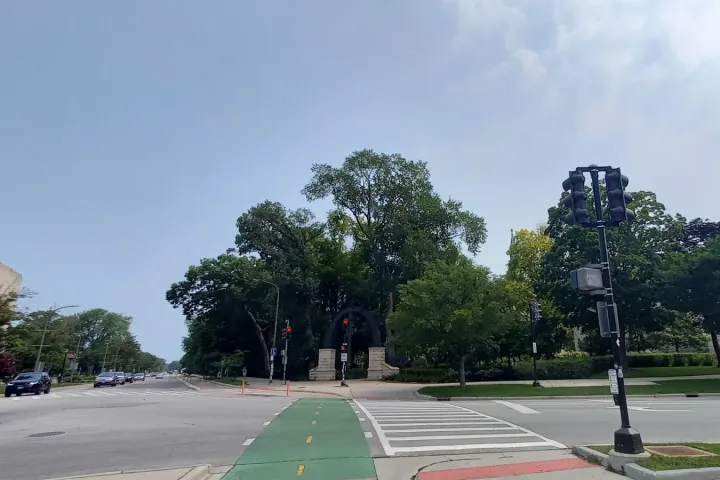
Catharine W. McCulloch Park in Evanston, named for the suffrage lawyer. Photo: Nick Number / Wikimedia Commons, CC BY 4.0
When Catharine Waugh McCulloch won an Evanston election in 1907, a lawyer for her opponent argued that she could not hold the office at all. Women could not vote, he said, and so could not hold a constitutional office. The state’s attorney general disagreed, and she took her seat.
Law school and a hard start
McCulloch was born Catharine Gouger Waugh on June 4, 1862, in New York state. She graduated from Rockford Female Seminary in 1882, writing a thesis on women’s wages, then studied at Chicago’s Union College of Law, a predecessor of today’s Northwestern Pritzker School of Law. She passed the bar in 1886. Finding it hard to get work in Chicago because she was a woman, she went back to Rockford, Illinois, and opened her own practice.
In 1890 she married a law school classmate, Frank Hathorn McCulloch. The two moved to Chicago and merged their practices as McCulloch and McCulloch.
Justice of the peace
McCulloch was elected justice of the peace in Evanston in 1907 and re-elected in 1909, making her the first woman elected to that office in Illinois. The challenge to her eligibility rested on the fact that Illinois women could not yet vote in most elections. The attorney general advised the governor to grant her commission, and her opponent lost the next election.
A suffrage strategist
Her courtroom work ran alongside decades of suffrage organizing. She became legislative chair of the Illinois Equal Suffrage Association in 1890 and, in 1894, helped found the Chicago Political Equity League to campaign for municipal suffrage. She also served as legal adviser to the National American Woman Suffrage Association and as its first vice president.
Her most concrete legislative contribution was drafting Illinois’s presidential suffrage bill. Lawmakers introduced it for roughly 20 years before it passed in 1913, making Illinois the first state east of the Mississippi River to let women vote for presidential electors. In 1916 she became the first woman nominated by a major party as a presidential elector. She received 950,229 votes, but the Republican ticket carried Illinois, so she did not serve.
Life in Evanston
The Evanston Women’s History Project says the McCullochs moved into a house in Evanston in 1895, and she lived in the city until her death. The project lists her address as 2236 Orrington Ave. and ties her to the Evanston Political Equality League. It records that she was elected on April 2, 1907, and served two terms. The couple had four children: Hugh, born in 1891, Hathorn in 1899, Catharine in 1901 and Frank Waugh in 1905.
The project also notes that she wrote plays highlighting women’s need for stronger legal protections, along with nonfiction and fiction on laws affecting mothers and children. Her legislative post with the Illinois Equal Suffrage Association, according to the same source, lasted 22 years.
McCulloch died on April 20, 1945, at Evanston Hospital after a two-week illness related to cancer. She was 82. Evanston has a park named for her, Catharine W. McCulloch Park, where a marker for the National Votes for Women Trail was placed in 2021.
Add The Evanston Edge as a preferred source on Google (opens in a new tab)
Thomas Brennan covers property taxes, real estate, transit and the local economy for The Evanston Edge.