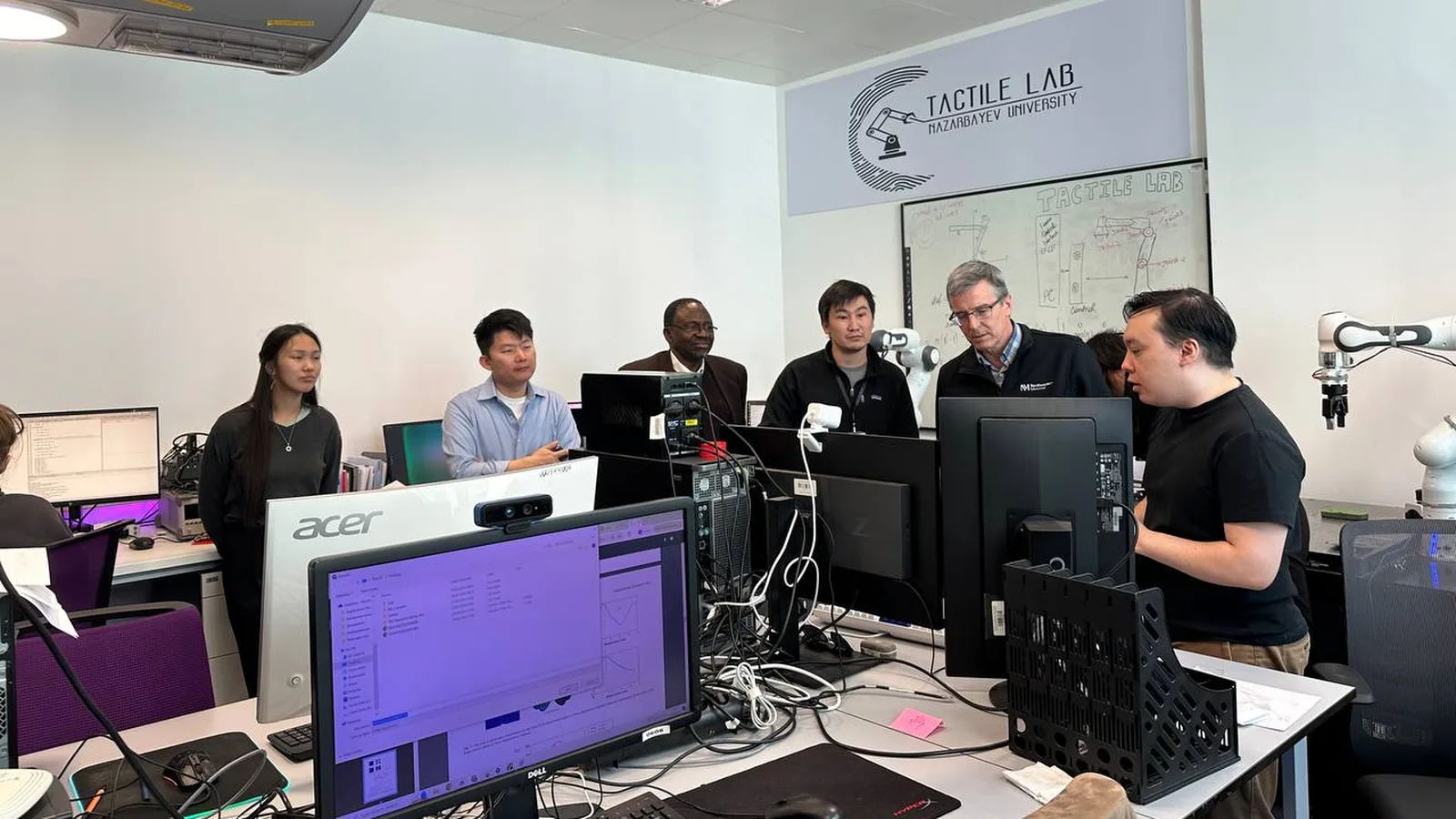
John Rogers of Northwestern University during a visit to Kazakhstan. Photo: ZhanatKappassov / Wikimedia Commons, CC0
Electronics are usually hard, flat and rigid. John Rogers has spent a career making them soft, stretchable and, in some cases, dissolvable. At Northwestern University, whose main campus is in Evanston, that work now underpins a set of medical devices and several companies.
From Bell Labs to Illinois to Northwestern
Rogers studied chemistry and physics at the University of Texas at Austin, graduating in 1989, then earned his master’s degrees and Ph.D. at MIT, finishing in 1995. After a fellowship at Harvard he joined Bell Laboratories in 1997 and later directed a research department there. In 2003 he moved to the University of Illinois Urbana-Champaign. He then came to Northwestern as the first Louis Simpson and Kimberly Querrey Professor and became the first director of the Center for Bio-Integrated Electronics. In 2019 that center grew into the Institute of Bioelectronics, which now carries the Querrey Simpson name.
His appointments span materials science and engineering, biomedical engineering and neurological surgery. A MacArthur Fellowship came in 2009, and he was elected to the National Academy of Engineering in 2011. In 2025 the Royal Society in London elected him a foreign member, and the Daily Northwestern reported that he won its Bakerian Medal and Lecture that August.
Devices that sit on skin or dissolve in the body
The research starts with soft materials such as polymers, combined with thin ribbons, wires and membranes of other materials, assembled into circuits that bend with human tissue. Applications named in his biography include dissolvable wireless pacemakers, brain implants for optogenetics and environmental sensors. Dissolvable, or bioresorbable, devices matter because they can do a temporary job and then disappear, sparing a patient a second surgery to remove them.
Some of that work has drawn wide attention. The Daily Northwestern noted in 2026 that a Northwestern wireless pacemaker, described as the tiniest of its kind, was named to TIME’s list of best inventions of 2025.
Rogers’ group has also worked on wearable sensors for newborns. Northwestern’s technology-transfer office says validation studies on premature babies began in 2017 at Lurie Children’s Hospital of Chicago, and a later comparison of wireless and wired monitors included 42 babies in Kenya. The aim is to replace tangles of wires on fragile infants with a soft patch that sends data wirelessly.
Startups and industry partners
Several companies grew from the lab. Northwestern’s technology-transfer office lists Rogers as a co-founder of Sibel Health, Epicore Biosystems, Rhaeos, Neurolux and Wearifi. Sibel Health was founded in 2019 and is led by Dr. Steve Xu, a dermatologist at Northwestern’s Feinberg School of Medicine, along with former members of Rogers’ group. It makes soft, wireless devices for monitoring vital signs in hospitals and at home, and philanthropic funding has supported deployments in several African countries. Northwestern has disclosed that the university, Rogers and Xu hold financial interests in Sibel Health and Rhaeos.
In December 2020 the chip company Maxim Integrated pledged $750,000 over 10 years to support the institute’s work on next-generation medical sensors.
In an April 2026 interview with the Daily Northwestern, Rogers described his group’s focus as patients at the earliest and latest stages of life, a description that fits both the neonatal sensors and the work aimed at older adults with conditions such as Parkinson’s and dementia.
Whether these devices reach routine use will depend on regulators, hospitals and manufacturers, not just on the lab. But the pipeline is unusually complete. Prototypes get built, tested on patients in hospitals, and in some cases handed to a company, all within the same research community.
Thomas Brennan covers property taxes, real estate, transit and the local economy for The Evanston Edge.