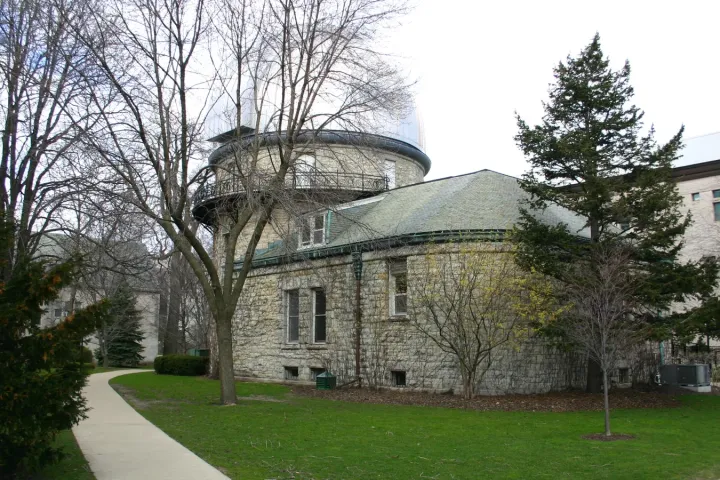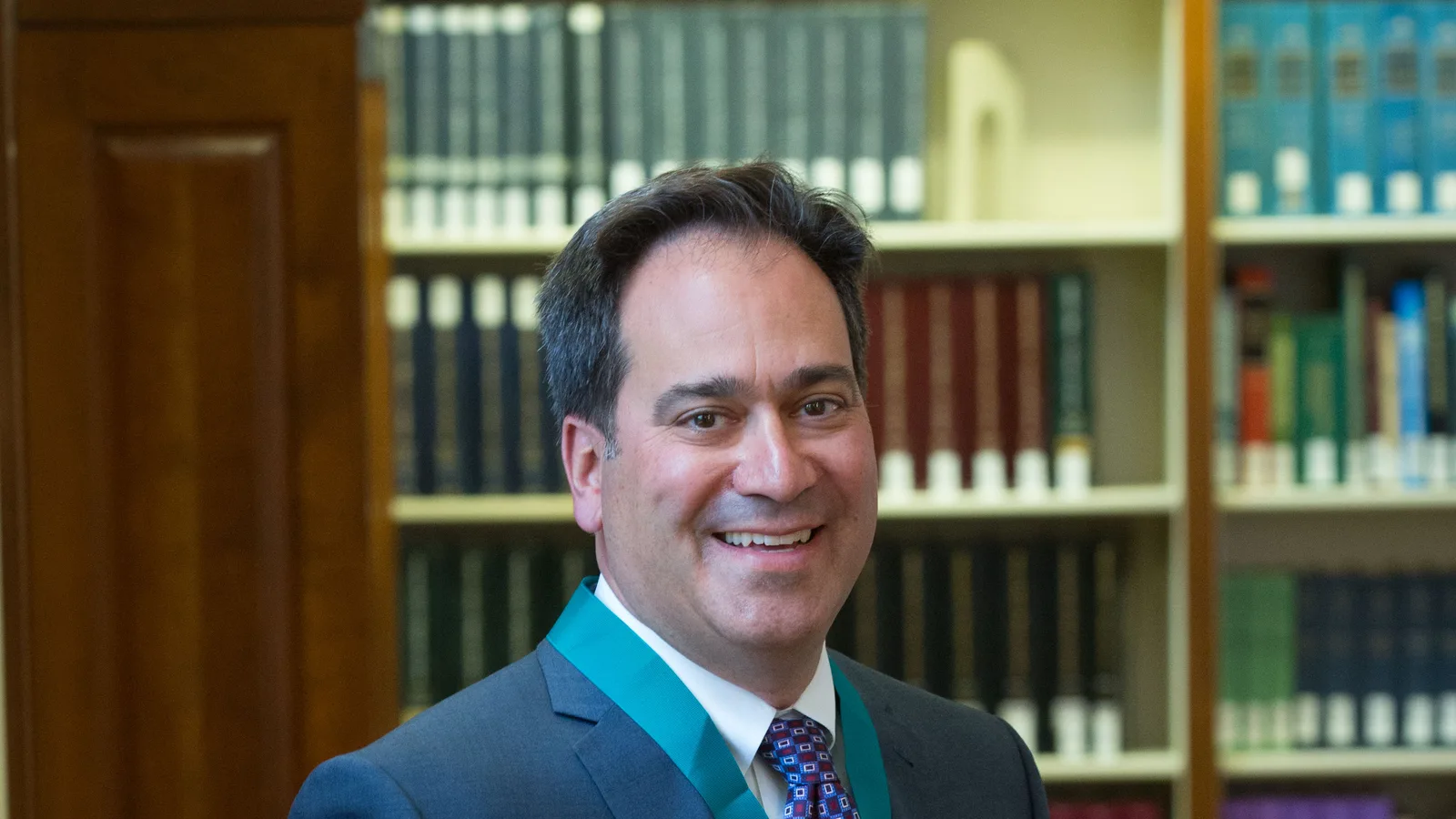
Chad Mirkin at the 2016 Heritage Day of the Chemical Heritage Foundation in Philadelphia, where he received the AIC Gold Medal. Photo: Conrad Erb / Wikimedia Commons, CC BY-SA 3.0
Most university chemists publish papers and move on. Chad Mirkin, a professor at Northwestern University in Evanston, has also started companies, several of them, on the strength of ideas first worked out in his lab.
Mirkin was born in 1963 in Phoenix, Arizona. He earned a bachelor’s degree from Dickinson College in 1986 and a Ph.D. from Penn State in 1989, then did a postdoctoral fellowship at MIT. He joined Northwestern in 1991. In 2000 he was named the George B. Rathmann Professor of Chemistry. He also holds appointments in medicine, materials science, biomedical engineering and chemical and biological engineering.
Working at the scale of a billionth of a meter
His research concerns structures between one and 100 nanometers across, thousands of times thinner than a human hair. Two inventions stand out.
The first is dip-pen nanolithography, a technique that uses a sharp tip, in the manner of a pen, to deposit molecules onto a surface in patterns at nanoscale precision. National Geographic counted it among the top 100 scientific discoveries that changed the world. Mirkin’s group later developed related tools, including polymer pen lithography and beam pen lithography.
The second is the spherical nucleic acid, or SNA. In 1996 his group published work attaching strands of DNA to gold nanoparticles in a dense shell. The structure behaves differently from a free DNA strand, and it became the basis for diagnostic tests and for experimental therapies. The same work helped launch a field in which researchers use DNA to guide how nanoparticles assemble into larger crystals.
From the lab bench to the market
Mirkin co-founded several companies, including NanoInk, Nanosphere, Azul 3D, TERA-print, Exicure and Stoicheia. The best-documented outcome is Nanosphere, a diagnostics company built around nanoparticle-based testing. Luminex acquired it in 2016 for about $83 million. Exicure, another company on the list, works on drugs based on spherical nucleic acids. NanoInk commercialized the lithography tools.
The same page says Mirkin has published more than 955 manuscripts and holds more than 1,400 patents and applications. Those are large numbers for an academic, and they explain why university technology-transfer staff in the Chicago area watch his lab closely.
An institute at Northwestern
Mirkin directs the International Institute for Nanotechnology at Northwestern, along with the Center for Nanofabrication and Molecular Self-Assembly. The institute pulls together researchers from chemistry, engineering, medicine and physics, which fits his own habit of working across departments.
He has collected a long list of honors. They include election to the National Academy of Engineering in 2009 and the National Academy of Sciences in 2010, a Lemelson-MIT Prize in 2009, the Perkin Medal in 2019 and the Kavli Prize in Nanoscience in 2024. He served on President Obama’s Council of Advisors on Science and Technology from 2009 to 2017.
For Evanston, Mirkin matters beyond the prizes. His career is a working example of how a campus lab can feed local employment: spinouts need scientists, lawyers, manufacturers and investors, and the Chicago region has supplied some of each. Whether any single company succeeds is never certain, and the record is mixed. But the pattern, a Northwestern discovery moving into a product, is the one that regional economic planners most want to see repeated.
Add The Evanston Edge as a preferred source on Google (opens in a new tab)
Thomas Brennan covers property taxes, real estate, transit and the local economy for The Evanston Edge.