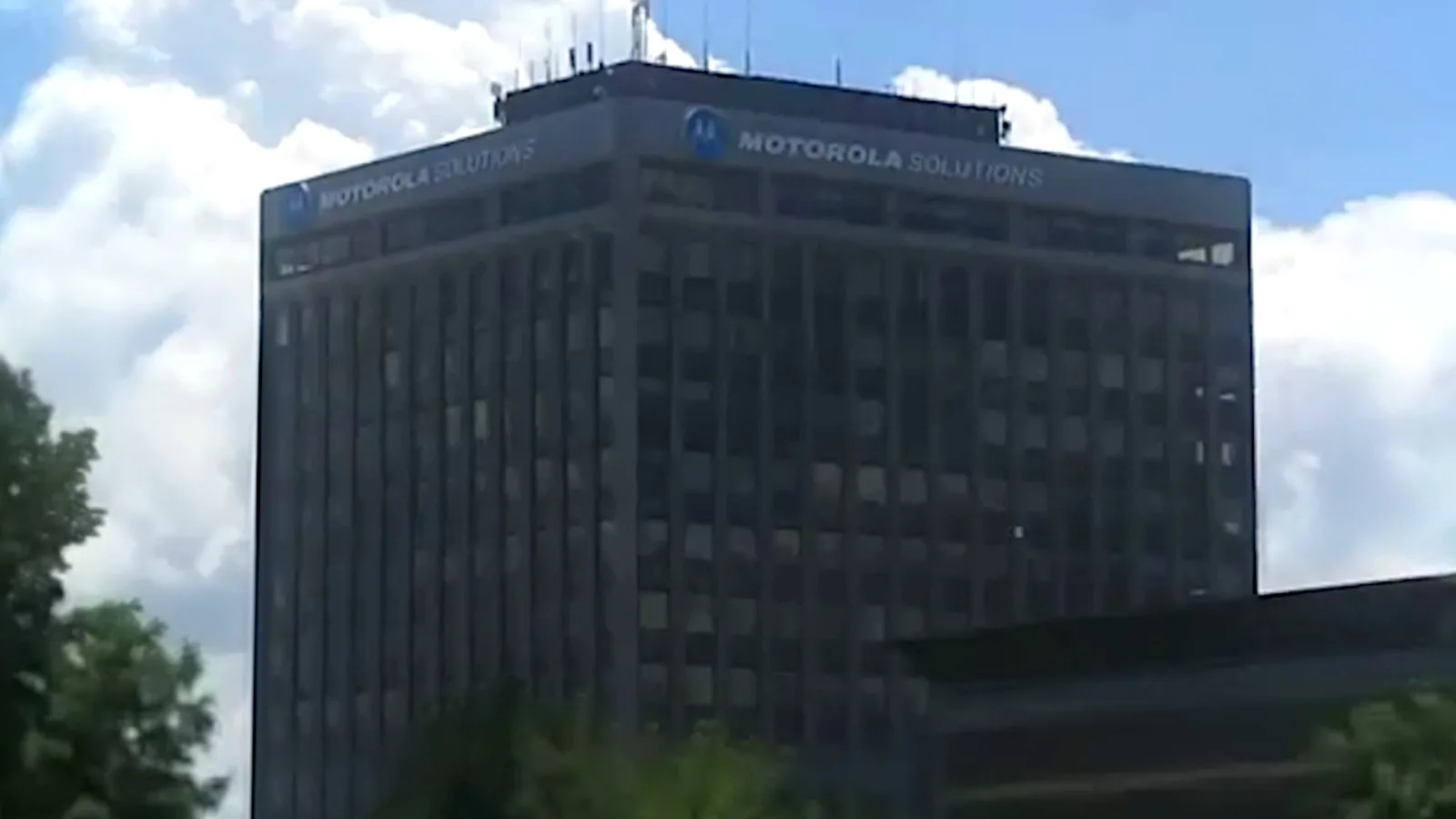
Motorola headquarters in Schaumburg, Illinois. Photo: Rey Ty / Wikimedia Commons, CC BY 3.0
Robert W. Galvin, known as Bob, ran Motorola for three decades and helped turn a radio maker into a global electronics company. Before that, he went to high school in Evanston.
He was born on Oct. 9, 1922, in Marshfield, Wisconsin, the son of Motorola founder Paul Galvin. The National Academy of Engineering’s memorial tribute says he attended Evanston Township High School and then the University of Notre Dame. The Television Academy, in its obituary, likewise says he went to high school in Evanston.
Running Motorola
Galvin joined the company in 1944. He became president in 1956 and chief executive in 1959 after his father died. Under him, the National Academy of Engineering says, annual sales grew from $290 million in 1959 to $10.8 billion in 1990, when he stepped back from day-to-day control. He remained board chair until 2001.
Motorola’s products in those years made the company a household name: a DynaTAC cellphone prototype in 1973, the first commercial cellular call over Ameritech’s network in 1983, the MicroTAC in 1989 and the StarTAC in 1996. The company also built semiconductors and supplied radios for NASA’s crewed flights. Galvin pushed it overseas as well, and the academy calls Motorola the first major U.S. corporation to set up operations in China.
Quality as a strategy
Motorola developed Six Sigma, a method that aims for no more than 3.4 defects per million opportunities. Galvin is credited with helping put it in place alongside engineers Mikel Harry and Bill Smith. In 1988 the company won the first Malcolm Baldrige National Quality Award in the manufacturing category. General Electric later adopted Six Sigma, and Jack Welch credited it with changing the company’s DNA.
How he managed
According to the academy’s tribute, Galvin saw engineers as the heart of the company and asked employees to call him Bob. He created recognition programs, including a Gold Badge for engineers holding more than 10 patents. He attended technology reviews himself and promoted technology roadmapping. The tribute says he argued for respect, integrity, training and fair pay across the company’s worldwide management team, and believed in continuing to innovate even in mature, profitable businesses, since new ideas often start with one person.
After Motorola
Galvin chaired the Illinois Institute of Technology’s board from 1979 to 1990, and he and Robert Pritzker each pledged $60 million to the school’s 1996 capital campaign. In 2005 he founded the Galvin Electricity Initiative, which sought to bring the electrical grid up to Six Sigma standards. With his sons Christopher and Michael, he also co-founded the real estate investment firm Harrison Street. He wrote America’s Founding Secret (2002) and Perfect Power (2008).
Honors included the National Medal of Technology and Innovation, the IEEE Founders Medal, the Vannevar Bush Award and the French Legion of Honor. He also advised several presidents and chaired the 1995 Department of Energy laboratories review known as the Galvin Commission.
Galvin died on Oct. 11, 2011, in Chicago at age 89, survived by his wife of 67 years, Mary Barnes Galvin.
Daniel Okafor covers business, startups and the Innovators section for The Evanston Edge.