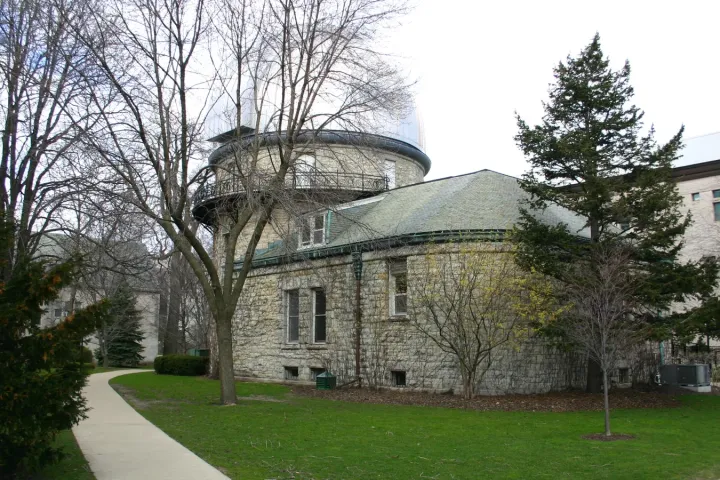
The Harley Clarke Mansion on the Evanston lakefront, home of the Evanston Art Center from 1965 to 2015. Photo: Paul R. Burley / Wikimedia Commons, CC BY-SA 4.0
The Evanston Art Center describes itself as among the oldest and largest arts centers in Illinois. It began in 1929 in the basement of the city’s public library, and the person most often credited with starting it was a children’s author and songwriter named Alice Riley.
Who Alice Riley was
Alice Cushing Donaldson Riley wrote children’s poetry, stories, songs and one-act plays. Her best-known work is the lullaby "Slumber Boat," written with the composer Jessie Gaynor. Riley lived in Evanston from 1898 to 1931 and later retired to Pasadena, California. Published biographies give conflicting birth and death years, so those are left out here.
Before the art center, she was involved in local cultural groups, including the Riley Circle and the Drama Club of Evanston, which are credited with building interest in the arts around town.
The 1929 start
Time Out Chicago says the center was founded in 1929 by Riley, who wanted a way to honor a beloved local art teacher, Julia Ferguson. The Evanston Women’s history site, which lists Riley as founder, says the center was created with the help of 20 civic organizations. From 1929 to 1943, it operated out of the basement of the old Evanston library.
In 1929, while she was splitting her time between Evanston and Pasadena, she outlined a plan for the center, worked with the library board and helped win approval of the resolutions and programs. A committee appointed members and planned the opening, which took place on Oct. 28, 1929, in rooms at the Evanston Public Library.
The names of the 20 organizations are not given in the sources reviewed, so they are not listed here. The structure is the notable part. The center did not begin as one wealthy patron’s project or a city program. It grew from a group of local clubs and civic bodies that agreed to share an art space.
From library basement to lakefront mansion
The center became a nonprofit in 1942. In 1966, the City of Evanston leased it the Harley Clarke House on Sheridan Road for a nominal fee, according to the Evanston Women’s site, and it stayed at the lakefront mansion until 2015. During the 1980s it also rented studio space at the Noyes Cultural Arts Center.
In 2015 the center moved to 1717 Central St., a former office building of about 20,000 square feet. A $2.5 million capital campaign paid for the move. Its programs include classes, lectures, exhibitions and community outreach. Past exhibitions have included Dimensional Lines: Art + Dress in 2011, Undefinable: Women’s Health in America in 2017 and Multiple Perspectives in 2018.
Why the founding story is worth knowing
Plenty of arts institutions credit one person with their creation, and the story usually turns out to involve many people. That seems true here. The record points to Riley as the organizer and to a broad coalition behind her, working through the public library, which gave the fledgling center a free place to meet.
The details are thin in places. Published accounts of Riley and the art center are thin on citations, and sources do not agree on every date. What holds up across them is the core: 1929, Alice Riley, about 20 local organizations and a library basement.
For a center that has since occupied a lakefront mansion and an office building on Central Street, that is a modest origin. It was also, going by the record, a durable one.
Add The Evanston Edge as a preferred source on Google (opens in a new tab)
Daniel Okafor covers business, startups and the Innovators section for The Evanston Edge.