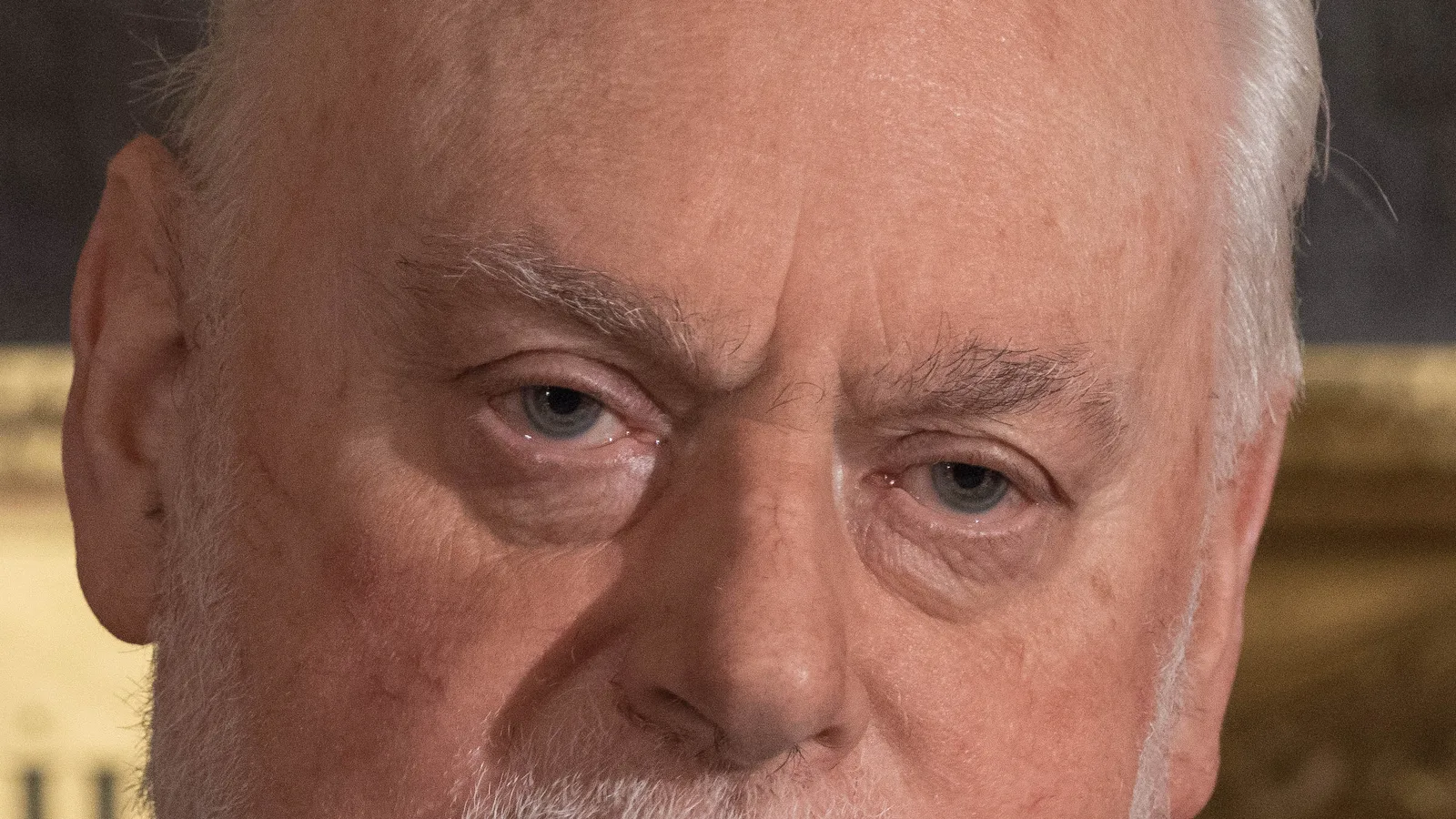
Fraser Stoddart during the 2016 Nobel Prize events in Stockholm. Photo: Bengt Nyman from Vaxholm, Sweden / Wikimedia Commons, CC BY 2.0
When Sir Fraser Stoddart arrived at Northwestern University in 2008, he was already one of the best-known chemists working on tiny machines. Eight years later he was a Nobel laureate. He died on Dec. 30, 2024, at age 82, and Northwestern had been his professional home for the last, and arguably most celebrated, chapter of his career.
A Scottish chemist’s long road
Stoddart was born in Edinburgh on May 24, 1942, and earned his bachelor’s degree and Ph.D. at the University of Edinburgh. He held posts in Canada, at the University of Sheffield, at Imperial Chemical Industries and at the University of Birmingham before moving to UCLA in 1997. At UCLA he directed the California NanoSystems Institute and held the Fred Kavli Chair in Nanosystems Sciences. At Northwestern he became a Board of Trustees Professor and, in 2010, director of the Center for the Chemistry of Integrated Systems.
He was knighted for services to chemistry and molecular nanotechnology. Northwestern’s obituary dates the honor to 2007.
What a mechanical bond is
Ordinary molecules are held together by chemical bonds in which atoms share electrons. Stoddart worked on a different kind of link, the mechanical bond, in which two parts are locked together the way two links of a chain are, without being chemically fused. A rotaxane, for example, is a ring threaded onto a thin axle with bulky ends that keep it from slipping off. A catenane is two or more rings interlocked.
The trick is making them in useful yields. Stoddart is credited with efficient synthetic methods for rotaxanes and catenanes that rely on attraction between an electron-poor ring and electron-rich guest molecules. Northwestern says that in 1991 he made a rotaxane and then showed the ring could shuttle along the axle. From there came molecular switches, which could be driven chemically, electrically or by light, and later work on a molecular lift, a molecular muscle and a molecule-based computer chip. In 2004 his group reported molecular Borromean rings, three interlocked rings, in the journal Science.
The 2016 prize
In 2016 Stoddart shared the Nobel Prize in Chemistry with Jean-Pierre Sauvage and Bernard Feringa, honored for the design and synthesis of molecular machines. Northwestern notes that he was the second Nobel laureate from its chemistry department.
The practical uses are still early. Molecular machines are not yet in everyday products, and much of the value so far lies in showing that controlled motion is possible at the scale of single molecules. Stoddart himself pushed toward applications. He was associated with a skincare brand, Noble Panacea, introduced in 2019, and H2MOF, a startup he co-founded to work on hydrogen storage and transport.
Teacher and mentor
Northwestern says he mentored more than 500 graduate and postdoctoral students and published more than 1,300 papers. His honors included election to the U.S. National Academy of Sciences in 2014, the Royal Society of Edinburgh’s Royal Medal in 2010, the Davy Medal, the Feynman Prize in Nanotechnology and the King Faisal International Prize in Science.
In his later years he took a chair at the University of Hong Kong, and he held a part-time post at the University of New South Wales in 2017 and 2018. He died in Melbourne, Australia, where he was visiting his daughter.
Daniel Okafor covers business, startups and the Innovators section for The Evanston Edge.