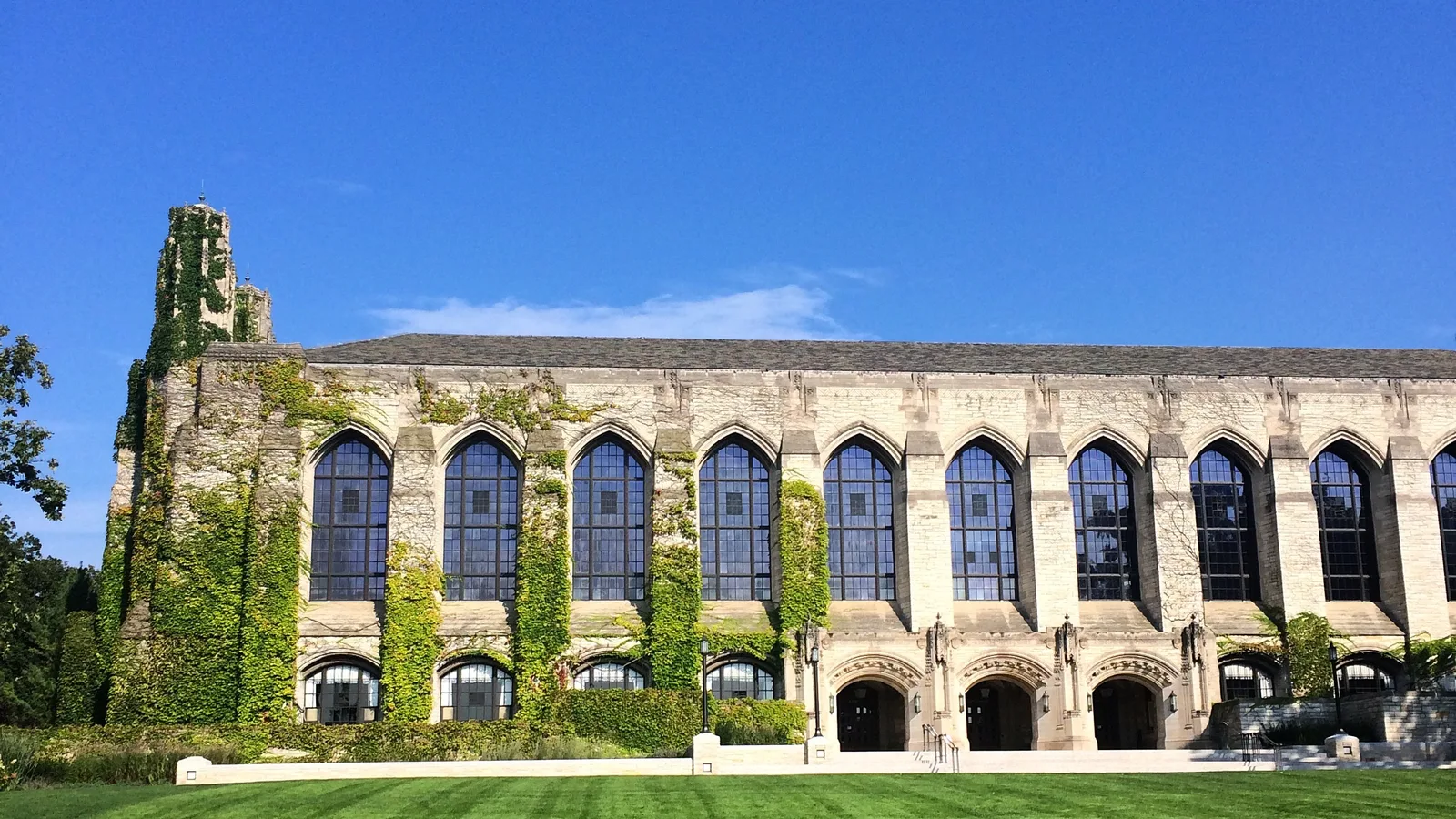
Deering Library on the Northwestern campus, named for the Deering family. Photo: Lacrossewi / Wikimedia Commons, CC BY-SA 4.0
Before International Harvester, there was Deering. William Deering, born in South Paris, Maine, on April 25, 1826, built one of the nation’s biggest farm-machinery businesses and then put much of his fortune into Evanston, mostly through Northwestern University.
From dry goods to binders
Deering began in the cloth trade. He won a contract during the Civil War to make uniforms for Union troops, then opened a dry goods firm after the war. Around 1870 he partnered with Elijah Gammon and put up $40,000 to produce a horse-drawn harvester developed by William and Charles Marsh. Time magazine later told the story this way: Gammon assured Deering the machine was better than anything McCormick built, and Deering invested, moved to Evanston and soon bought out his partner.
The company became Gammon & Deering in 1873 and Deering Manufacturing Company in 1879, when Deering took full ownership. In 1880 it sold 3,000 binders that used John Appleby’s twine-tying mechanism, which earned more than $400,000 in profit. Deering moved the operation to Chicago that year and set up the Deering Harvester Works. He retired in 1901. In 1902, with his son directing the deal, Deering, McCormick and Plano merged into International Harvester.
Northwestern’s quiet benefactor
Northwestern’s own magazine says Deering served on the university’s Board of Trustees for 38 years and was board president from 1895 to 1905. Time reported that from 1876 until his death he gave the school $1 million in 55 gifts, many of them small. At the time, the article said, the Methodist-founded university was struggling and had learned early to count on him.
Northwestern says his gifts funded the first two science faculty chairs and helped build Fisk Hall. Trustees repeatedly proposed renaming the school Deering University, but he declined. A portrait of him painted by Anders Zorn in 1899 hangs in Deering Library.
That library is named for the family, though the money came from the next generation. The magazine credits his son Charles and grandson Roger with giving more than $7 million for the Charles Deering Library, which stands across Sheridan Road from the main campus.
The family and the end
Deering’s second marriage, in 1857, was to Clara Barbour Cummings Hamilton. His first wife, Abby, had died around 1856, when Charles was about four years old.
Deering had three children who reached adulthood: Charles, born in 1852 to his first wife, Abby Reed Barbour, and James and Abby Marion with his second wife, Clara. James is remembered for Vizcaya, his estate in Miami.
After retiring, Deering spent much of each year at a winter home in Coconut Grove, Florida. He died there on Dec. 9, 1913, at 87, and was buried at Graceland Cemetery in Chicago.
In the late 1890s he also bought about 60,000 acres in Pemiscot and Dunklin counties in Missouri, and a lumber town west of Caruthersville carries his name. His other philanthropy included Garrett-Evangelical Theological Seminary and Wesley Hospital in Chicago.
Plenty of Evanston institutions carry the names of industrialists. Deering’s is among the few that also reflects decades of steady, sometimes unglamorous giving to a school that needed it.
Daniel Okafor covers business, startups and the Innovators section for The Evanston Edge.