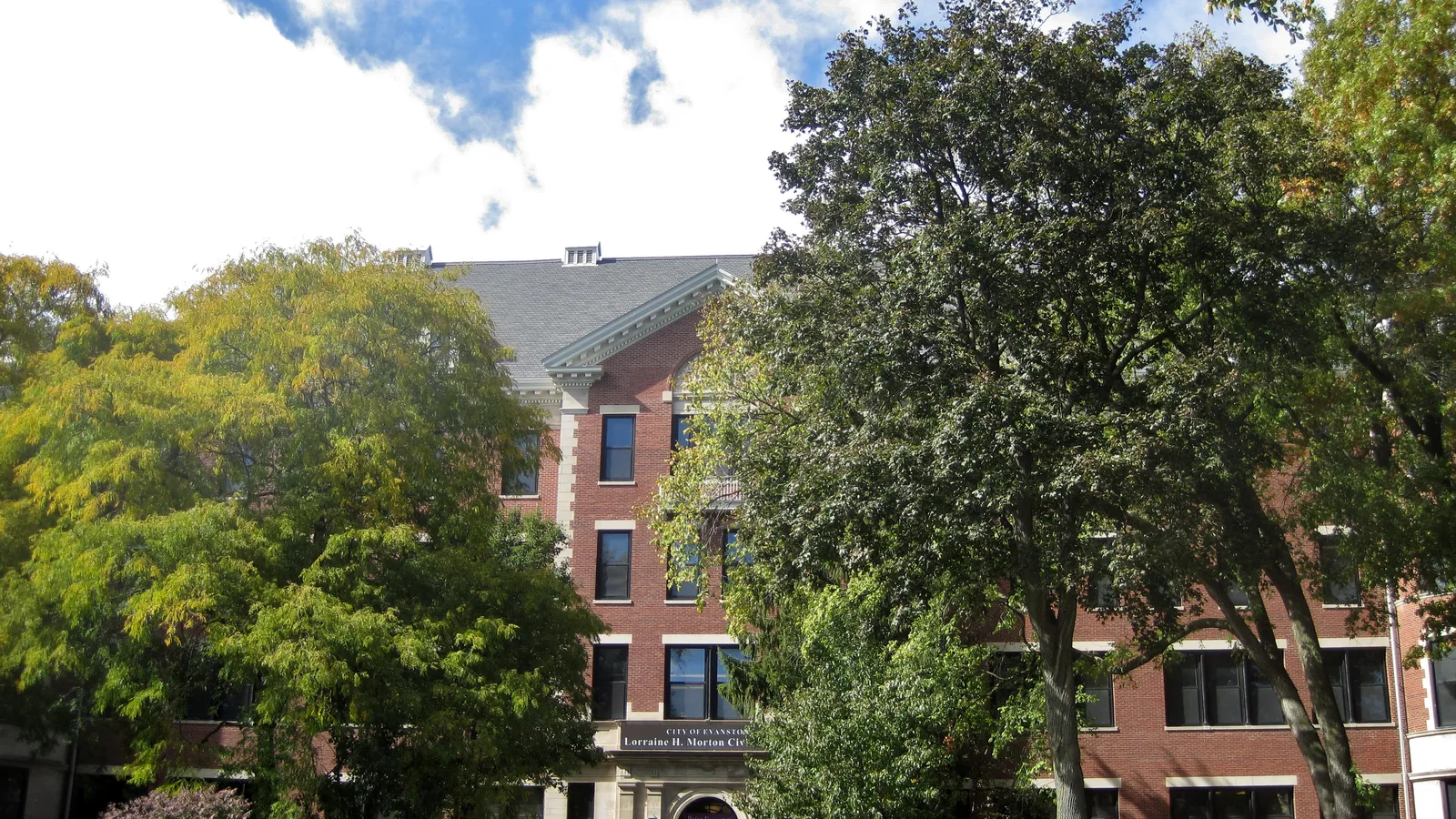
The Evanston Civic Center, the former Marywood Academy building, which the city bought after the school closed. Photo: Teemu008 from Palatine, Illinois / Wikimedia Commons, CC BY-SA 2.0
For five years, the City of Evanston did not raise its property tax levy. The proposed budget City Manager Luke Stowe released on Oct. 6, 2025, would end that run, and the arguments over it say a good deal about how a city of this size pays its bills.
What was proposed
The proposal covers the 2026 fiscal year and totals about $404 million in expenditures when operating transfers are counted, according to the Daily Northwestern’s reporting, a 2.1 percent increase over 2025. Much of the growth is tied to bond-funded capital projects. Within that, the city’s levy would rise by $6.5 million, with the money aimed at human services, pension contributions and parks.
The percentages depend on what is counted. The Daily Northwestern’s headline cited a 12.9 percent increase, while its report put the city’s own levy increase at 13.7 percent. The Evanston Public Library board had separately recommended a 10 percent increase in September. Because the city’s share is only about 16 percent of a typical Evanston bill, as the city’s tax explanation page says, a city levy increase of this size works out to a much smaller rise in a homeowner’s total bill.
Why the gap opened
The city’s reasoning, as reported, has three parts. First, prices. The Daily Northwestern reported that the Consumer Price Index has climbed 25 percent since property taxes were last raised, while the levy stayed where it was. Second, pensions. Contributions to public safety pensions are projected to rise about $727,000 in fiscal 2026, to $30.3 million, and $3 million of the proposed levy increase goes into the pension levy to cover it. Third, reserves. In earlier years the city avoided raising the levy by drawing on savings built from one-time permit revenue and federal stimulus money. That cushion does not refill on its own.
The aggregate deficit in the 2026 plan was reported to be almost $18 million smaller than the 2025 gap, so the budget was already tighter before any new levy dollars.
Infrastructure and other pieces
The capital side is large. About $90 million would be spread across twelve funds in 2026, and the five-year capital plan runs past $500 million. The Capital Improvements Fund and the Water Fund each get roughly $37 million. The budget also freezes previously scheduled water rate increases, expands the CARE alternative response program and includes a new community benefits agreement with Northwestern. Starting in 2026, parks and recreation operations move out of the General Fund into their own fund, with projected revenues and expenses of about $16.3 million, so the General Fund looks smaller on paper than in past years.
Staff also flagged federal exposure. The city receives about $2.2 million a year in HUD entitlement grants, plus $1.7 million in carryover funds, and losing them would force cuts or new revenue to keep housing programs going.
The process
The city published a budget process overview alongside the proposal. The reported calendar had City Council discussion on Oct. 13, a Finance and Budget Committee meeting on Oct. 14 and a budget public hearing at the Oct. 27 council meeting, with adoption to follow later in the fall. Aldermen did not simply accept the proposal: the Daily Northwestern’s November 2025 coverage described the council moving to cut the proposed increase.
Whatever the final number, the pattern is the useful part for homeowners. A freeze eventually meets rising pension payments and construction costs, and a levy that has not moved in five years rarely moves just a little when it finally does.
Sources: the Daily Northwestern’s Oct. 8, 2025, coverage of the proposed budget and the City of Evanston’s property tax explanation page.
Thomas Brennan covers property taxes, real estate, transit and the local economy for The Evanston Edge.