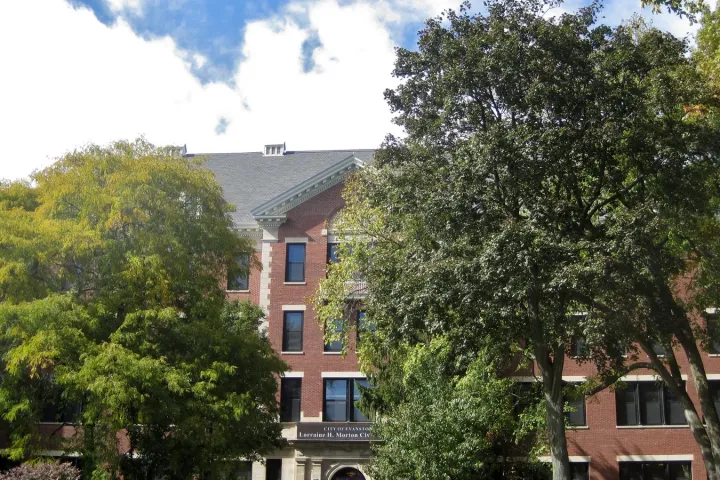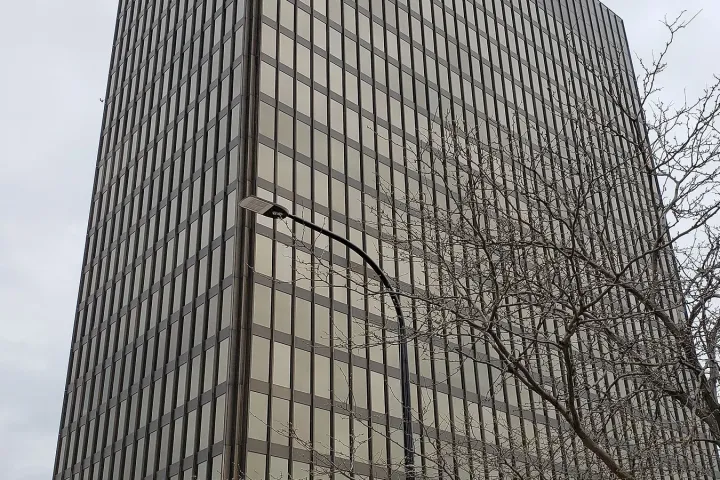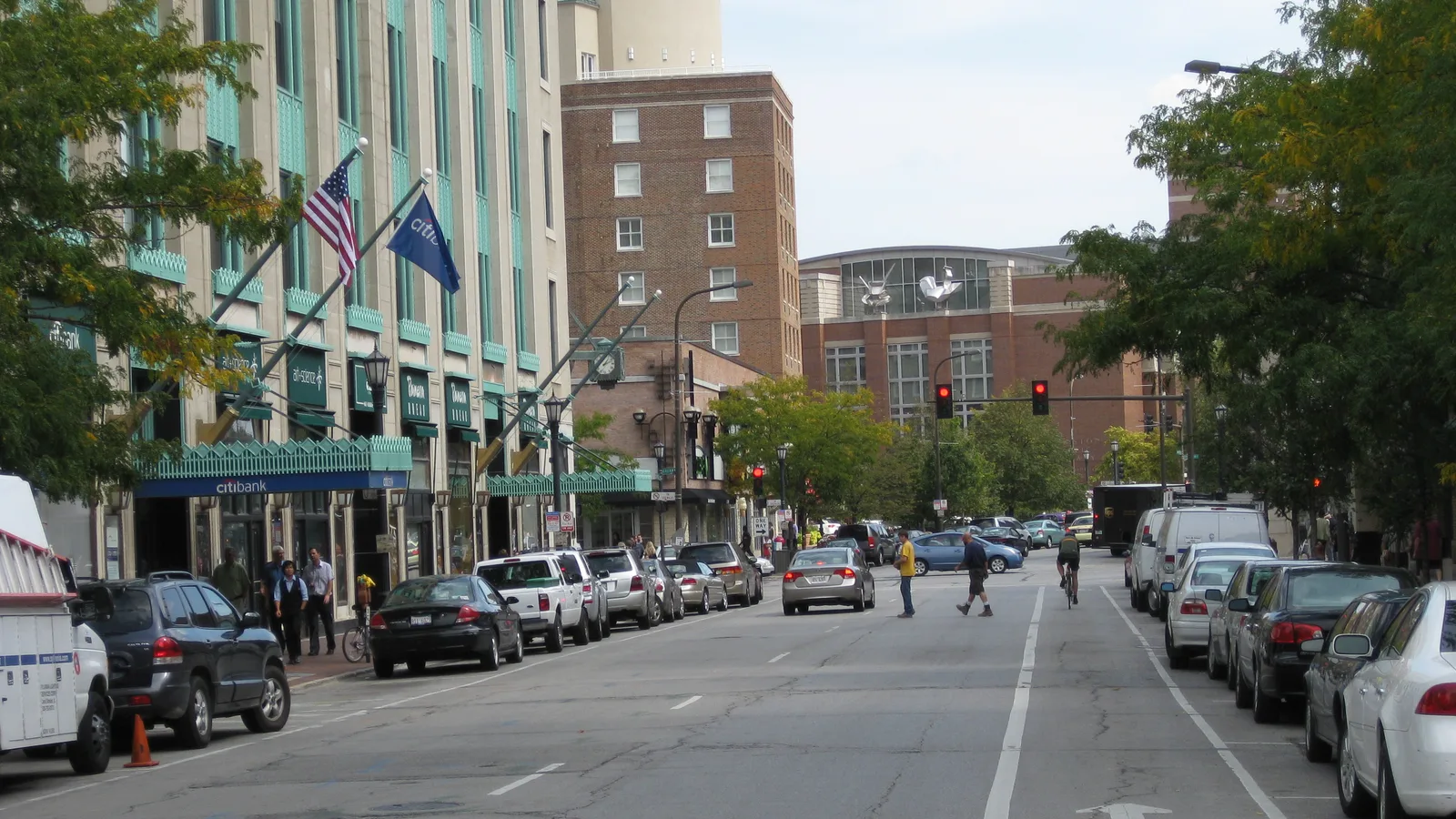
Office and residential buildings along a downtown Evanston street with a bike lane. Photo: Eric Fredericks from Rancho Cordova, CA, United States / Wikimedia Commons, CC BY-SA 2.0
Most people picture hedge funds in Greenwich or lower Manhattan. One of the better-known ones in the Midwest keeps its headquarters in Evanston. Magnetar Capital is a multi-strategy alternative asset manager based in the city, with additional offices in New York, London and Menlo Park, California.
Founding
Magnetar was founded in 2005 by Alec Litowitz, who had been at Citadel, and Ross Laser, formerly of Glenwood Capital Partners. It opened with $1.8 billion in capital, which made it one of the largest hedge fund launches of its time. David Snyderman has served as managing partner since 2022, succeeding Litowitz, and Laser is president. The firm has about 260 employees and roughly $18.6 billion in assets under management as of February 2025, according to Pensions & Investments.
In 2015, Blackstone’s hedge fund unit bought a minority stake in Magnetar. Management stayed in place.
What the firm does
“Alternative asset manager” is a broad label, and Magnetar spreads across several approaches. Its alternative credit and fixed income business covers specialty finance, including significant risk transfer deals, in which a bank shares some of the risk on a pool of its loans with outside investors. The firm counts 12 such deals totaling $724 million across 2023 and 2024. A quantitative arm runs rules-based strategies such as systematic risk arbitrage, systematic convertible arbitrage and equity statistical arbitrage. A fundamental and event-driven group makes more traditional, judgment-based investments. In 2024 the firm added a ventures effort aimed at early- and growth-stage artificial intelligence and technology companies.
The AI connection runs deeper than that. Magnetar became a major equity holder in CoreWeave, the cloud computing company, beginning with a $50 million convertible note in 2021 and continuing through later funding rounds. It was the largest beneficiary of CoreWeave’s 2025 initial public offering. Other holdings include Cohere and TensorWave, a Dublin auto lender, European real estate and film financing with 20th Century Fox.
The 2000s controversy
No profile of Magnetar is complete without the “Magnetar trade.” In 2006 and 2007 the fund invested in the equity portions of collateralized debt obligations, reportedly around $30 billion worth, while hedging with credit default swaps on other slices. ProPublica later alleged that this activity worsened the mortgage market’s collapse, while stating that Magnetar did not cause the crisis or the housing bubble. The firm has said it did not control the selection of assets in those deals and did not make an overall bet against housing, and it describes its positions as market neutral.
Regulators looked at related deals. The SEC sued JPMorgan Chase in 2010 over a 2007 transaction involving securities Magnetar had a hand in selecting, and JPMorgan settled for $153.6 million in 2011. The SEC also investigated Magnetar’s possible influence on a Merrill Lynch CDO but took no enforcement action against the firm.
A North Shore address in a Chicago industry
Chicago has long been a center for trading and quantitative investing, and Magnetar’s founders came out of the Citadel and Glenwood Capital world. For Evanston, the firm is a sizable financial employer in a town better known for Northwestern, health care and retail.
Because Magnetar is a private firm, much of what is public comes from regulatory filings and trade press. The figures above reflect those outside accounts rather than the firm’s own statements, and assets under management shift with markets and investor flows.
Thomas Brennan covers property taxes, real estate, transit and the local economy for The Evanston Edge.