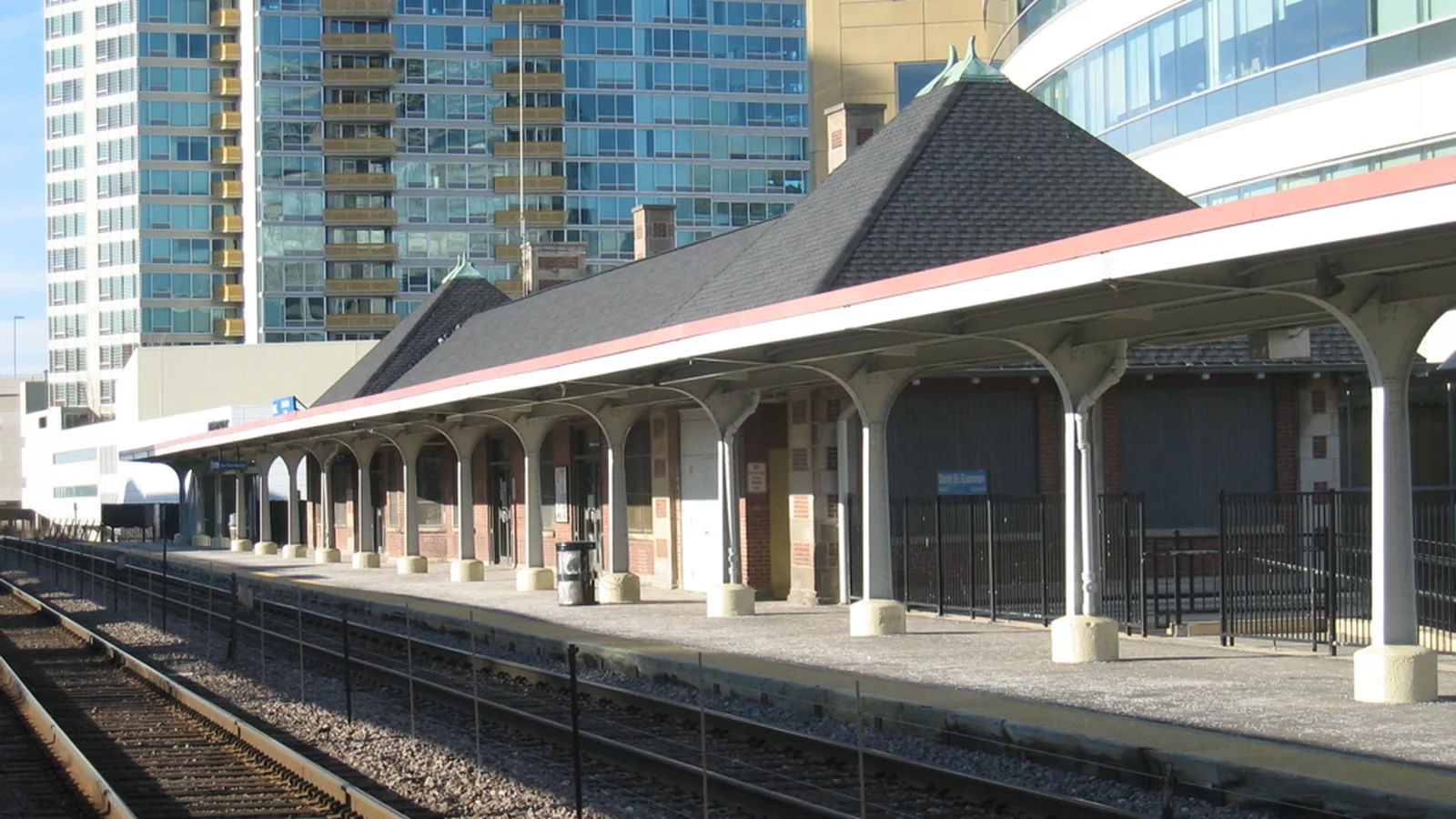
The Davis Street Metra station in downtown Evanston. Photo: User:JeremyA / Wikimedia Commons, CC BY-SA 2.5
The Regional Transportation Authority released a video in early 2013 making the case for transit-oriented development, the practice of putting housing, offices and shops close to train stations. Built around business owners, residents and local officials, the video listed the benefits as higher transit ridership, less traffic congestion, better walkability and new economic development opportunities.
Evanston is a natural example. It has CTA, Metra and Pace service, and several large projects were underway or planned within walking distance of the stations.
The projects
- AMLI Evanston, at Chicago Avenue and Kedzie Street. The 214-unit apartment community was approved by the Plan Commission in 2008 and was close to completion. It sits within walking distance of the CTA and Metra Main Street stations and the CTA South Boulevard station.
- Central Station, east of the Metra Central Street station at Central Street and Eastwood Avenue.
- Focus Development, on the west side of downtown at Ridge Avenue and Clark Street, a few blocks from the CTA and Metra Davis Street stations.
- 1881 Oak Ave. and 1890 Maple Ave., a future development at the northwest corner of downtown, a few blocks north of the Davis Street stations.
- Main and Chicago, a proposed office development at the southeast corner of Main Street and Chicago Avenue, near the Main Street stations.
The Chicago Avenue corridor was busy that winter. The same stretch was getting a Trader Joe’s, with a groundbreaking scheduled for Jan. 31 at 1211 Chicago Ave., and a tax increment financing district covering the Main and Chicago area had just been approved.
Why stations matter to developers
A building near a platform can market itself to renters who commute to the Loop without owning a car, and it can often get by with less parking. AMLI’s plan, for example, called for 312 parking spaces for its 214 apartments plus a small group of shops. The wager is that residents who live a few minutes from a train will use it, which is the ridership gain the RTA described.
Whether the walkability and congestion benefits materialize depends on how the projects fill and what surrounds them. In early 2013 Evanston was making that bet in several places at once.
Sources: Regional Transportation Authority; Chicago Agent Magazine; Evanston Now.
Thomas Brennan covers property taxes, real estate, transit and the local economy for The Evanston Edge.