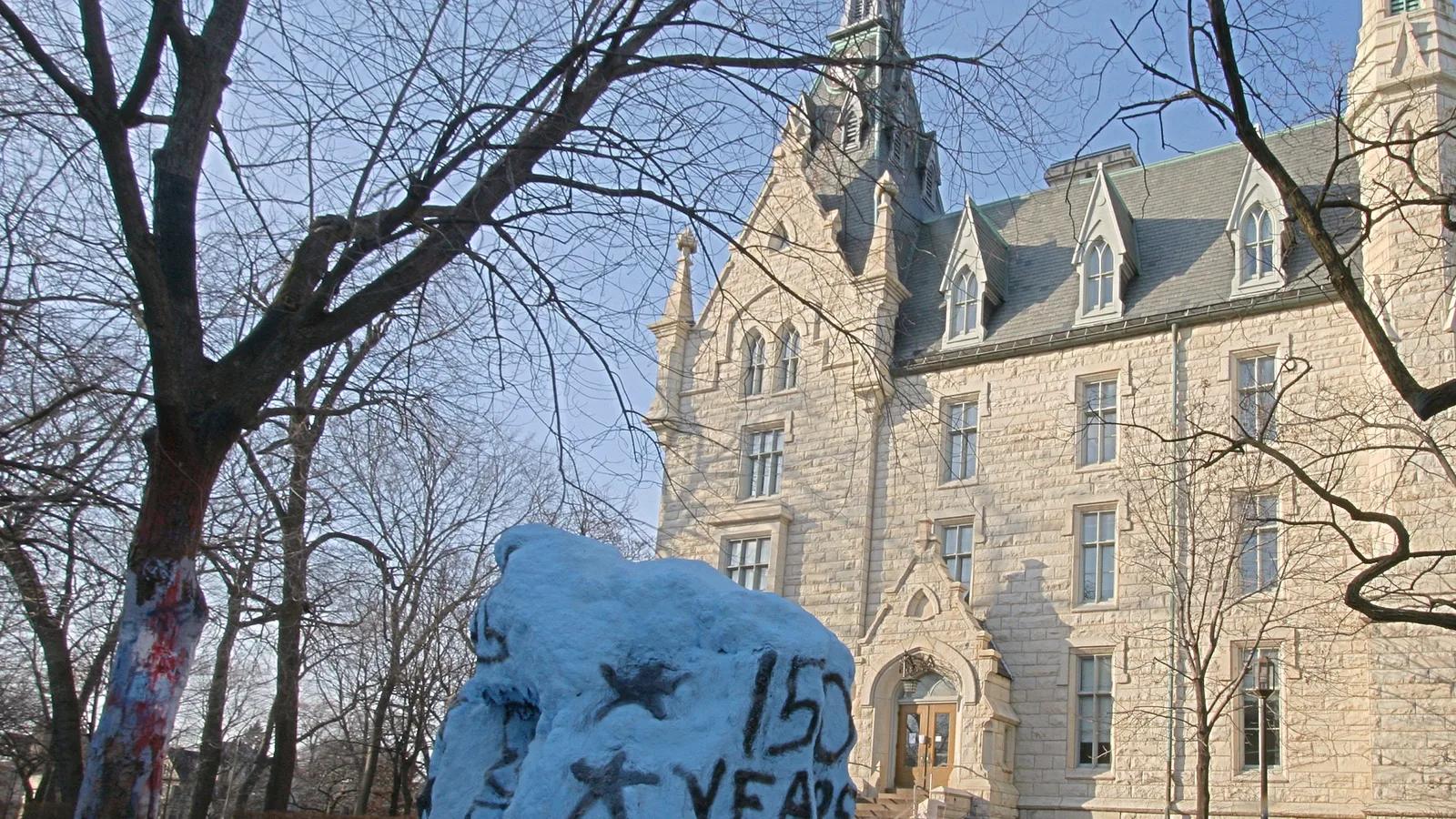
The Rock and University Hall on Northwestern University's Evanston campus. Photo: Madcoverboy / Wikimedia Commons, CC BY-SA 3.0
Anyone who has looked for work knows the odd arithmetic of the experience: employers say they cannot find people, and people say they cannot find employers. Both can be true at once. Explaining why was the life’s work of Dale T. Mortensen, a Northwestern University economist who shared the 2010 Nobel Memorial Prize in Economic Sciences.
From Oregon to Northwestern
Mortensen was born in Enterprise, Oregon, in 1939. He earned a bachelor’s degree at Willamette University in 1961 and a doctorate at Carnegie Mellon University in 1967. He had already joined Northwestern’s faculty in 1965, and in 1980 he became a professor at the Kellogg School of Management.
He served as president of the Society for Economic Dynamics and helped found the Review of Economic Dynamics. Before the Nobel, he received the IZA Prize in Labor Economics in 2005 and the Jacob Mincer Award in 2007.
The idea in plain terms
Textbook markets assume buyers and sellers find each other instantly. Real labor markets do not work that way. A worker has to learn which openings exist, apply, interview and wait. An employer has to advertise, screen and decide. Each step costs time and money, and economists call those costs search frictions.
Search and matching theory takes the frictions seriously. Workers and jobs are treated as two groups that must be paired, and the pairing takes a while. A worker may turn down an early offer because a better one could come along. An employer may leave a position open because the right candidate has not turned up. The result is that unemployment and vacancies exist side by side, even when the economy is healthy. Economists call the unemployment that results frictional.
The Royal Swedish Academy of Sciences honored Mortensen, Peter Diamond and Christopher Pissarides in 2010 for their analysis of markets with search frictions. Diamond laid groundwork on how search markets function. Mortensen and Pissarides extended that foundation to the labor market.
What the models were used for
Once unemployment is treated as the outcome of search, policy questions look different. The models show how unemployment, vacancies and wages respond to rules such as the level of jobless benefits and the terms of hiring and firing. One result often cited from the framework is that more generous benefits can lengthen the time workers spend searching, because they can afford to be choosier.
Mortensen extended the approach beyond unemployment. Biographical accounts note that he applied it to labor turnover, to research and development, and to personal relationships. Housing is another market where the logic fits, since buyers and sellers also take time to find one another.
Later years
Mortensen died at his home in Wilmette on Jan. 9, 2014, at age 74. In 2019 his family donated his Nobel medal to Northwestern.
His work does not promise a faster job hunt. What it offers is a better account of why the wait exists, and why a long search is often part of how labor markets sort people into work rather than a sign that something has broken.
Daniel Okafor covers business, startups and the Innovators section for The Evanston Edge.